How-to
Month pages
Draw a whole month as a poster, a memo board, a wall page or a desk pad, with a week start, notes of your own, and the grid as data.
monthCalendar draws a whole month as one SVG. It is its own import (@johnmorrisdotca/koyomi-calendars/month, about 11 kB), so the small icon never carries it. Dates are plain arithmetic with leap years by the Gregorian rule, the words come from Intl, and the library knows no holiday: every note on a day is yours.
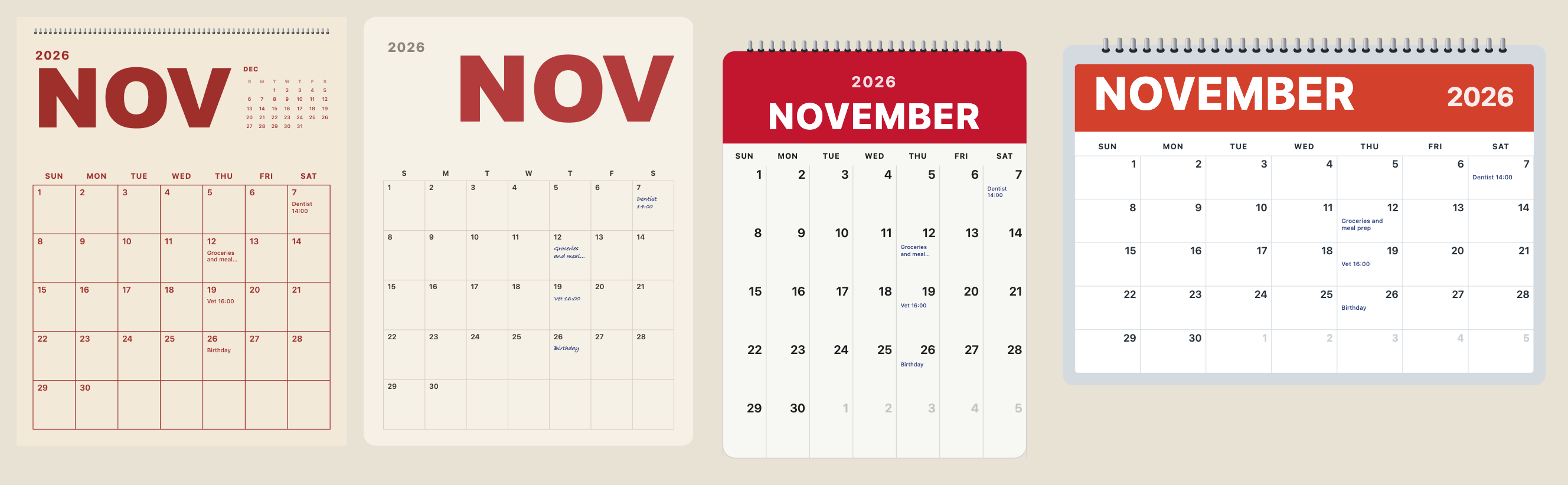
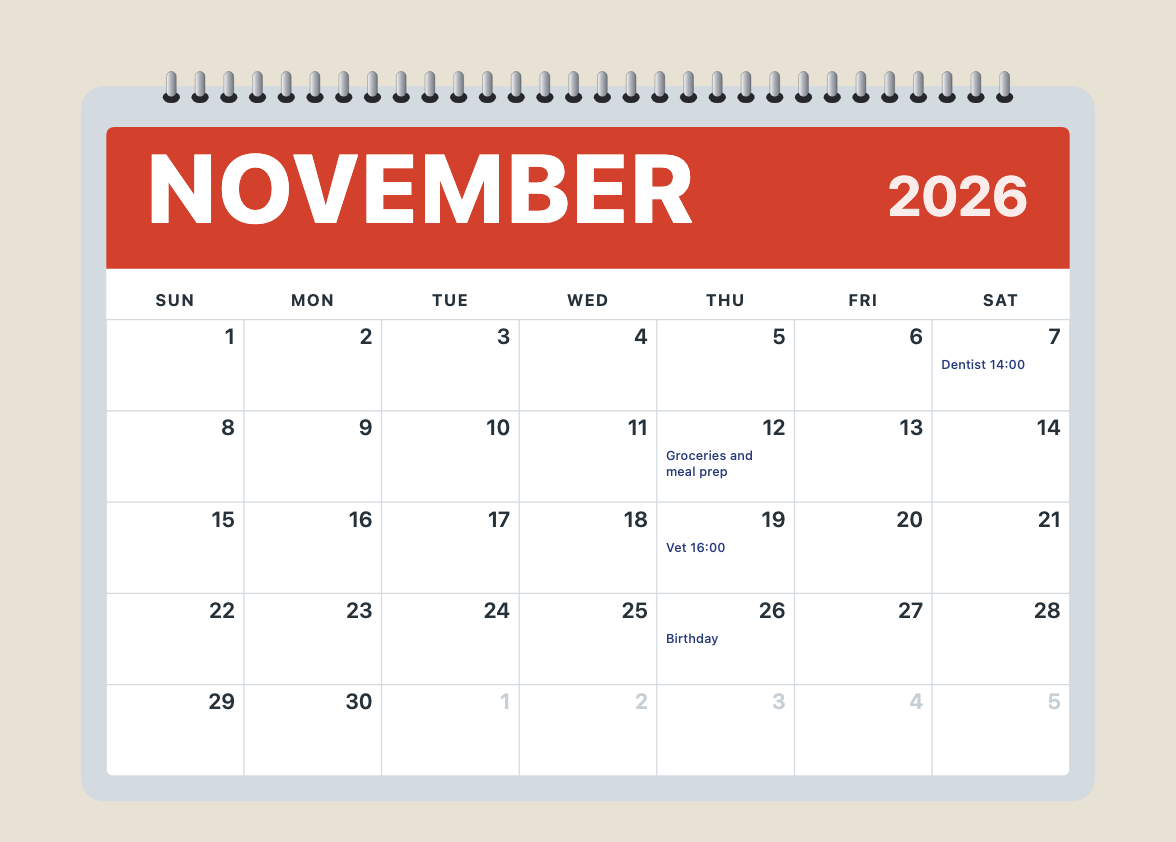
The four designs
design | |
|---|---|
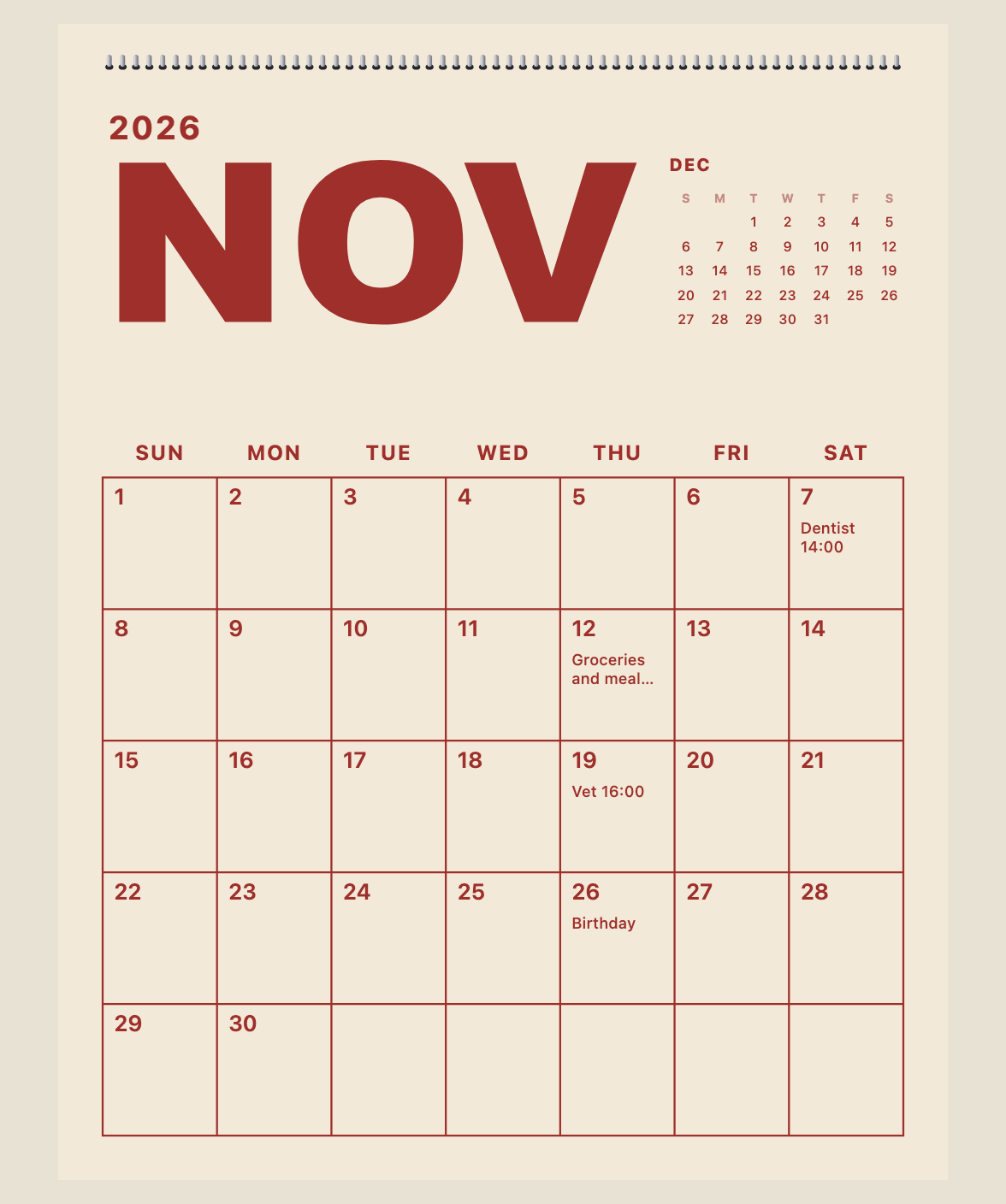
poster | a very large month word, a clean grid, a small calendar of the next month, room to write |
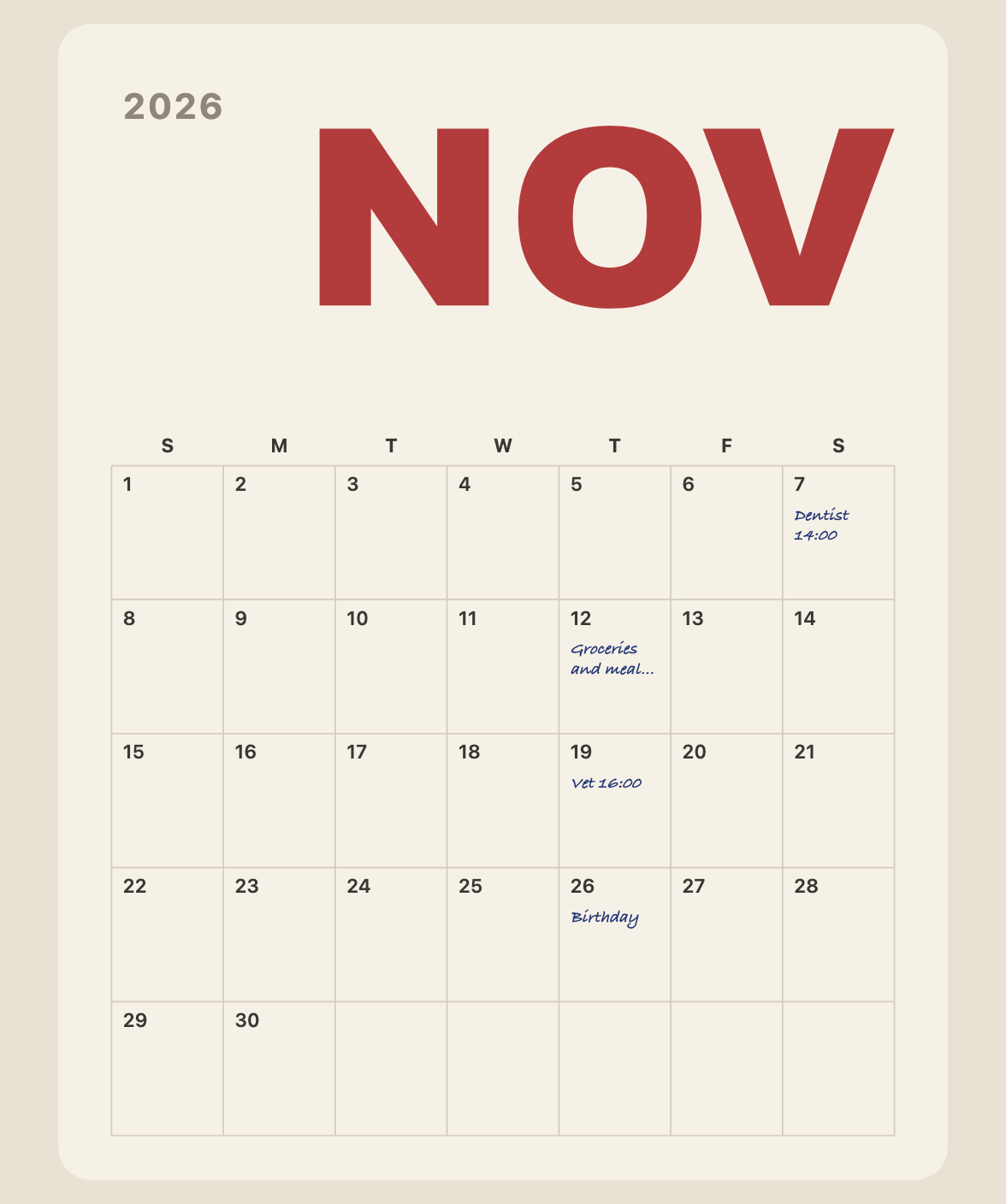
board | a memo board: a large month, a quiet grid, handwriting-style notes |
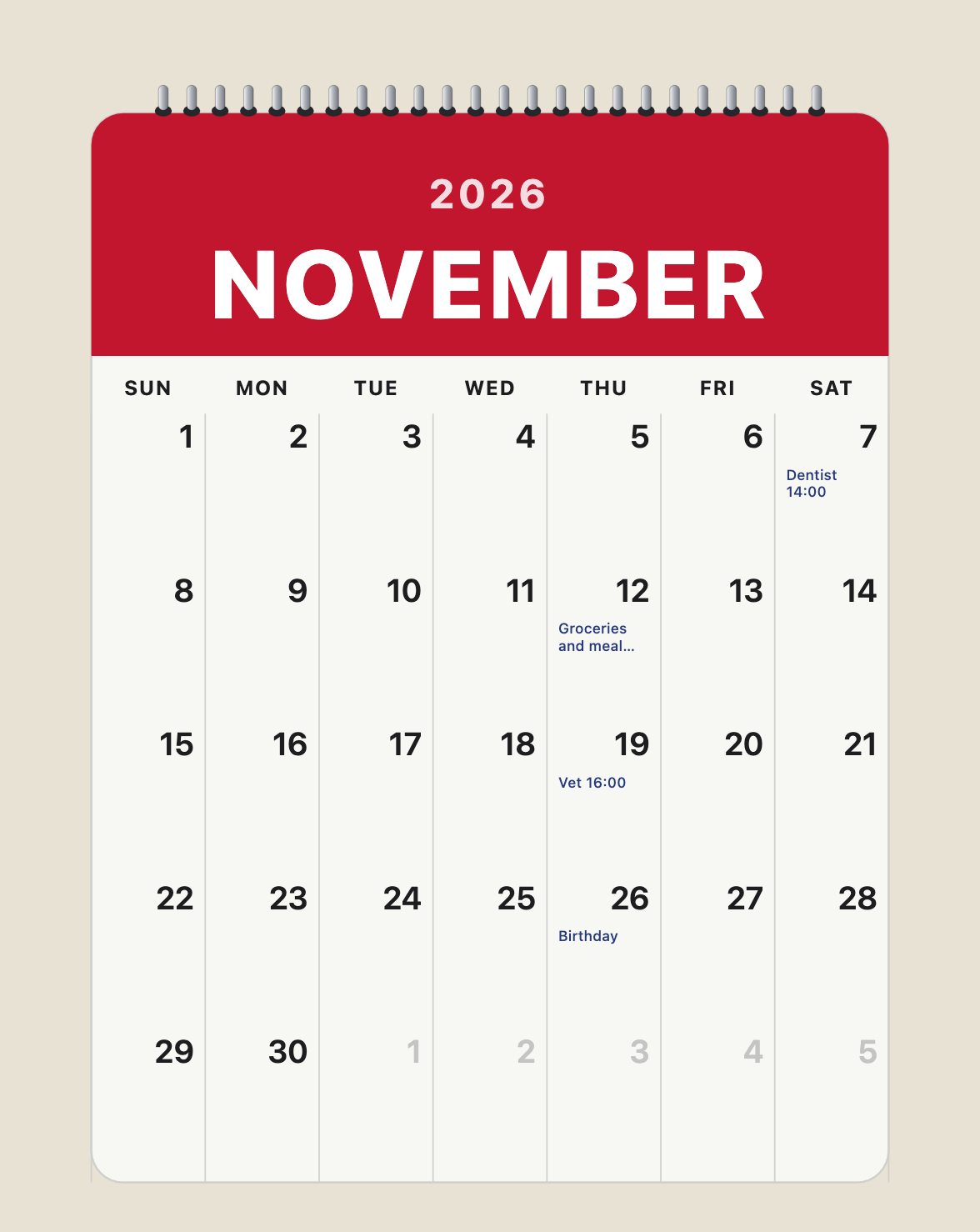
wall | a wall page with spiral binding at the top and a red header |
desk | a landscape desk pad with coils and a banner |
MONTH_DESIGNS lists them and MONTH_DESIGN_LABELS has their labels in English and Japanese.
import { MONTH_DESIGNS, MONTH_DESIGN_LABELS, monthCalendar } from "@johnmorrisdotca/koyomi-calendars/month";

console.log(MONTH_DESIGNS.join(" "));
console.log(MONTH_DESIGN_LABELS.wall.en);
const svg = monthCalendar({ year: 2026, month: 11, design: "poster", weekStart: "monday", scheme: "light" });
console.log(svg.includes('aria-label="November 2026"'));
// poster board wall desk
// Wall page
// true
poster board wall desk
Wall page
trueEach design alone, at a larger size:
Options
| Option | |
|---|---|
year, month | the month to draw; any year from 1 to 9999 |
design | one of the four; poster by default |
weekStart | "sunday" (the default) or "monday" |
locale | en or any locale Intl accepts; Japanese, Chinese and Korean put the year before the month |
scheme | "light" or "dark" |
size | width in CSS pixels; 480 by default |
notes | a short note by date ("2026-11-07") or for that day of every year ("11-07"); two lines fit |
tint | Saturday blue and Sunday red; on by default for Japanese only |
outside | the faint days of the months either side; on for wall and desk |
mini | the small next-month calendar of poster (on) and board (off) |
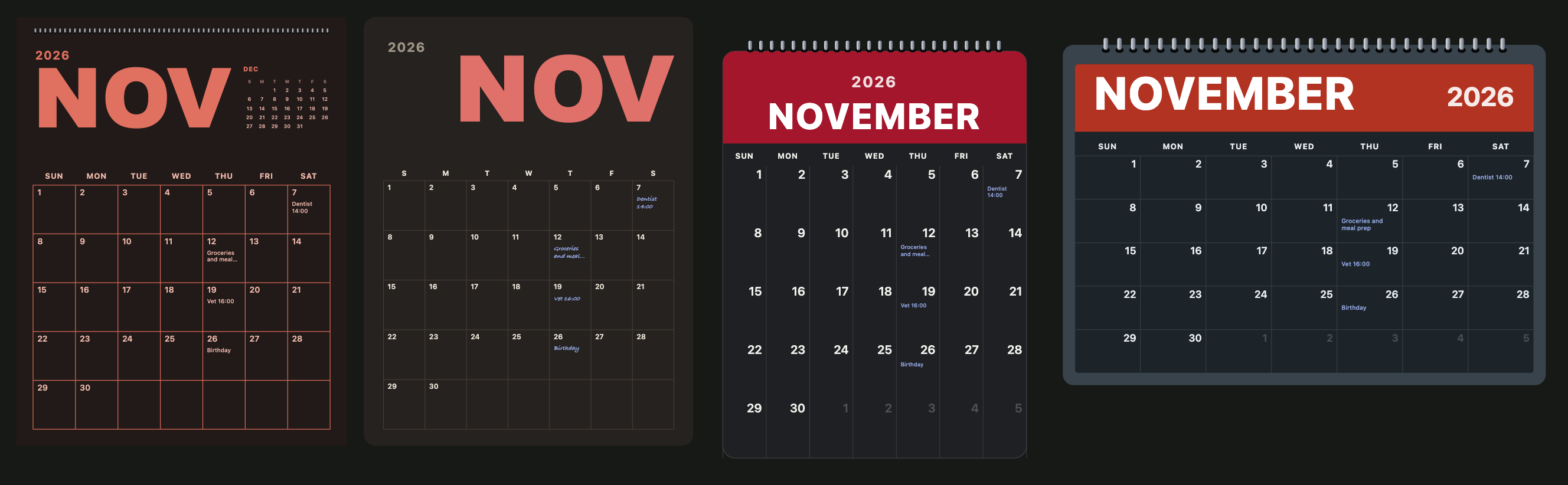
Notes
A note given by full date shows in that year only; one given as "MM-DD" shows every year. A note too long for its cell is cut to two lines and ends in an ellipsis.
import { monthCalendar } from "@johnmorrisdotca/koyomi-calendars/month";

const svg = monthCalendar({ year: 2026, month: 11, design: "board", notes: { "2026-11-07": "Dentist 14:00", "11-23": "Day off" } });
console.log(svg.includes("Dentist"));
const nextYear = monthCalendar({ year: 2027, month: 11, design: "board", notes: { "2026-11-07": "Dentist 14:00", "11-23": "Day off" } });
console.log(nextYear.includes("Dentist"), nextYear.includes("Day off"));
// true
// false true
true
false trueBecause the library holds no holiday data, a month that should show holidays is given them as notes. For Japan, japaneseHolidaysOf(year) computes the year's holidays and you can pass each one as a note: see The Japanese calendar.
Other languages
locale takes any locale Intl knows. The month and weekday words change, and Japanese, Chinese and Korean put the year before the month. For Japanese, Saturdays and Sundays are tinted by default.
import { monthCalendar } from "@johnmorrisdotca/koyomi-calendars/month";

const ja = monthCalendar({ year: 2026, month: 11, design: "wall", locale: "ja" });
console.log(ja.includes("2026"));
const fr = monthCalendar({ year: 2026, month: 11, design: "wall", locale: "fr" });
console.log(fr.includes("novembre"));
// true
// true
true
true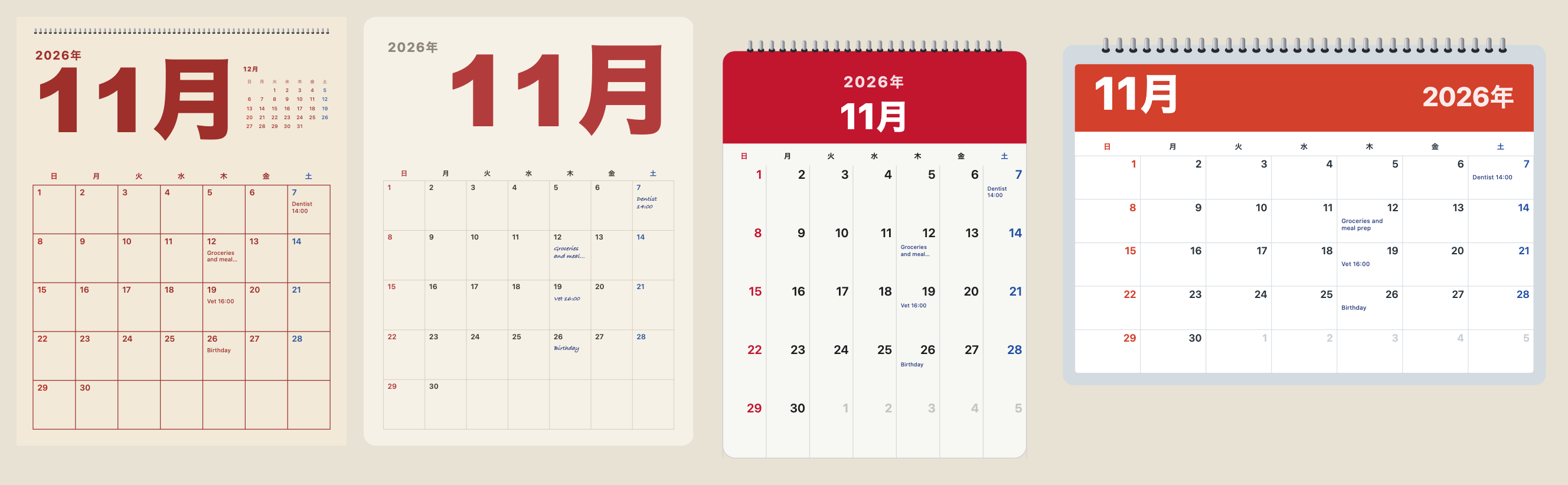
The grid as data
monthGrid gives the weeks without any drawing, for a design of your own: whole weeks of seven days, each day with its year, month, day, weekday (0 Sunday to 6 Saturday) and whether it belongs to the month. daysInMonth knows leap years.
import { daysInMonth, monthGrid } from "@johnmorrisdotca/koyomi-calendars/month";

console.log(daysInMonth(2024, 2));
console.log(daysInMonth(2100, 2));
const february = monthGrid(2026, 2, "monday");
console.log(february.weeks.length, february.offset, february.daysInMonth);
console.log(february.weeks[0][0].day, february.weeks[0][0].inMonth);
// 29
// 28
// 5 6 28
// 26 false
29
28
5 6 28
26 false