The pages are in English; this contents, the search and the buttons are in Japanese.
Circuits
日本語 · English
A race track drawn as OpenStreetMap maps it, and a simulated race on it (a race): the lap as a ribbon of the track's width along the ways of the circuit, the pit lane and the circuit's ground with its pit building, the start line and the chequered finish across the track, arrows the way the lap runs, each turn's number beside its bend, a north arrow and a scale bar. The first is the Las Vegas Strip Circuit, a street circuit on the Las Vegas Strip, Koval Lane, Harmon Avenue and Sands Avenue. The 3D view lays it on a floor that turns, with the pit building standing up and each turn's number on a post. Nothing of a race's, a series' or a team's is drawn: no logo, no sponsor, no mark.

import { circuitById, drawCircuit } from "@johnmorrisdotca/kyogijo-stadiums/circuits";

const svg = drawCircuit({ circuit: "las-vegas" });
console.log(svg.includes('data-turn="17"'), svg.includes("OpenStreetMap"));
// true true
const lv = circuitById("las-vegas")!;
console.log(lv.length.value, lv.corners.value, lv.direction.value, lv.width.basis);
// 6201 17 counterclockwise plausible
A circuit is an entry of its own, @johnmorrisdotca/kyogijo-stadiums/circuits, and not a sport of drawKyogijo: a lap is kilometres of road with no teams, no score and no crowd, drawn on a map's frame rather than a rulebook's, so the surfaces' machinery (the score panel, the stands, the frames of a data provider) has nothing to do there. It shares what fits: the 3D view and its controls, the light and dark themes, the credit of OpenStreetMap's data and the way real places are fetched, kept and checked (as the real venues are). The demo's circuits page draws it in 2D and 3D, in English and Japanese, with its facts and the code that draws what is shown.
What is drawn, and where it comes from#
| Part | From |
|---|---|
| The lap | OpenStreetMap: the ways of the circuit's relation with the role forward or backward, in the relation's order, each turned the way it is driven, joined end to end into one ring and simplified to half a metre. |
| The track's width | Ours: 12 metres, plausible. No source gives it (OpenStreetMap maps no width on the lap's ways, and neither article gives one). |
| The white edges | Ours: a line along each side of the ribbon, for the eye. They are not the kerbs. |
| The pit lane | OpenStreetMap: the relation's member with the role pit_lane, drawn 8 metres wide (ours: no source gives it). |
| The start line and the finish line | OpenStreetMap: the relation's nodes with the roles start and finish (tagged raceway=start and raceway=finish), drawn across the track: the start as a white line, the finish as two rows of squares. |
| The turns' numbers | OpenStreetMap: the relation's nodes tagged junction=yes with a ref of 1 to 17, one at each turn. The badge sits beside the outside of the bend, with a thin line to it, and is pushed apart from its neighbours where two would touch. |
| The direction | The English article: the lap runs counterclockwise (the Japanese article says the same); the relation's forward ways run that way too. Eight arrows along the lap show it. |
| The ground and the pit building | OpenStreetMap: the circuit's area (leisure=sports_centre, named for the circuit) and the building inside it beside the pit lane, 19.5 metres high in 4 levels (its height and building:levels). |
| Kerbs, run-off and gravel | None. OpenStreetMap maps none for racing here: the only kerbs within 60 metres of the lap are the streets' (lowered, with tactile paving, at the pedestrian crossings), and the drawing does not take them for a circuit's. |
| The north arrow and the scale | Ours, from the map: the drawing lies with the lap's long side along the page (a turn of the map, never a mirror), and the arrow points north. The scale bar is a round number of metres about a fifth of the drawing's width. |
The Las Vegas Strip Circuit#
| Fact | Value | Basis and source |
|---|---|---|
| Name | Las Vegas Strip Circuit (ラスベガス・ストリップ・サーキット on the Japanese page) | Wikidata's labels of Q113112116 |
| Length of a lap | 6.201 km | documented: the English infobox (revision 1376988769), which the Japanese infobox (revision 108197128) also gives. The Japanese article's prose says 6.120 km, which neither infobox nor the English article does, and it is not used. |
| Length of the drawn line | 6.210 km | measured along the lap as drawn: 9 metres, 0.15 percent, longer than the published length |
| Turns | 17 | documented: the English infobox, and its prose (14 corners when the race was announced, 17 after a chicane was added) |
| Direction | counterclockwise | documented: the English article |
| Opened | 2023-11-16 | documented: Wikidata's P1619 |
| Track width drawn | 12 m | ours, plausible |
| Pit lane width drawn | 8 m | ours, plausible |
How the length is held. The build (pnpm circuits) joins the lap from the raw answer of Overpass and stops if it does not close, if a turn is more than 2 metres off it or out of order, or if the line measures more than 3 percent from the published length. The ways measure 6,210.2 metres before they are simplified and 6,210.1 after; the lap is the middle of each one-way carriageway, not a racing line, so a little over the published 6,201 is what to expect. src/circuits.raw.test.js joins the lap again from the raw answer and holds the drawing to it: within a metre of its length, and every drawn point within the half-metre tolerance of the raw line.
The turns agree with the article. OpenStreetMap's numbers lie where the English article's account of the lap puts them: Turn 1, a hairpin after the pits; Turns 5 to 9 round the Sphere (the Japanese article); Turns 10 and 11 on Sands Avenue; Turn 12, a slow left onto Las Vegas Boulevard; Turn 13 on the Strip; Turns 14 to 16 onto Harmon Avenue; Turn 17, a fast left before the pits.
Beside it. T-Mobile Arena, which the package draws among the real venues, stands about 790 metres south-west of the nearest point of the lap, across the Strip from it: not beside the circuit, but near enough for a district that puts the two on one ground: planDistrict({ venues: ["t-mobile-arena"], circuit: "las-vegas" }), and with context the hotels of the Strip, the Sphere, the High Roller and the Fountains of Bellagio round them. The demo's district page has it as a preset.
Options#
| Option | What it does |
|---|---|
circuit | The circuit's key (CIRCUIT_IDS): las-vegas. Any other throws, naming the keys. |
language | en (the default) or ja: the name, the line of facts, the description and the table. |
theme | light or dark forces one; left out, the drawing follows the page and the device. The colours are custom properties (--ky-ci-*, KYOGIJO_CIRCUIT_STYLE). |
label | The name and the line of facts in the top left: true (the default) or false. |
turns | The turns' numbers: true (the default) or false. In 3D, false stands no marker on a post (the pit building still stands). |
arrows | The arrows along the lap: true (the default) or false. |
id, className, css | The prefix of the ids inside the drawing, more classes on the root, and css: "none" to leave the stylesheet out. |
circuitTable(options) gives the facts as a table, each with its basis; circuitPlan(circuit) the plan in the drawing's frame (feet, the lap's long side along x), with the length the drawn line measures; CIRCUITS, circuitById and the types are the data.
In 3D#

import { buildCircuitTurn, circuitTurnMarkup } from "@johnmorrisdotca/kyogijo-stadiums/circuits";

const model = buildCircuitTurn({ circuit: "las-vegas" });
console.log(model.planes.length, model.planes.filter((p) => p.kind === "sign").length);
// 68 17
const html = circuitTurnMarkup({ circuit: "las-vegas" }, { preset: "corner" });
console.log(html.includes('data-part="turn-17"'), html.includes("preserve-3d"));
// true false
import { mountCircuitTurn } from "@johnmorrisdotca/kyogijo-stadiums/circuits";

const view = mountCircuitTurn(document.querySelector("#lap")!, { circuit: "las-vegas" }, { preset: "corner" });
view.preset("overhead");
The floor is the circuit's own drawing, with its name left to the page and its turns' numbers standing up instead. On it stand the pit building, a block at the 19.5 metres OpenStreetMap maps (its walls and its roof, as a district's buildings are), and over each turn a round badge with its number on a thin post, turned to face the eye and leaning back to be read square on (it lies flat seen from straight above). The badges are markers, sized to be read (CIRCUIT_MARKER: a badge 30 thousandths of the drawing's longer side across, on a post 22 thousandths high): nothing of their size stands at a corner. uprights: false is the floor alone, with the numbers on it. The viewpoints are CIRCUIT_PRESETS: overhead, the main camera high over the long side, the end-on view and the low corner, each higher than a single surface's, since a lap is kilometres across and flat.
It is cheap. The view of Las Vegas is 68 planes (17 badges, their 34 post strips and 17 faces of the pit building) and 292 elements in all, against a soccer bowl's 110 planes and 500 elements; the floor is one SVG of 14.8 KB (3.7 KB gzipped). CIRCUIT_PLANES_MAX (120) holds every circuit's view to a budget, and a test holds the floor under 40 KB. The lap was simplified once, when it was built (228 points to 107, at half a metre), so nothing is simplified while the view turns.
It does nothing by itself. The view is every 3D view's (mountTurn): nothing moves until the reader turns it or presses Auto-turn, nothing is drawn while it is still, the auto-turn holds while the page is hidden or the view is scrolled out of sight, and the elements are made once and only moved, so nothing grows as it turns. The demo's test plays it and counts.
A race#
Try the race: circuits.html?race=1, live in the demo.

Try the race: circuits.html?race=1
import { raceAt, simulateRace } from "@johnmorrisdotca/kyogijo-stadiums/circuits";

const race = simulateRace({ circuit: "las-vegas" });
console.log(race.laps, race.cars.length, Math.round(race.flag / 60));
// 50 20 82
const now = raceAt(race, 1800);
console.log(now.lap, now.standings[0].position, now.standings[1].gap! < 1);
// 18 1 true
import { mountCircuitRace } from "@johnmorrisdotca/kyogijo-stadiums/circuits";

const race = mountCircuitRace(document.querySelector("#race")!, { circuit: "las-vegas" }, { view: "3d", speed: 10 });
race.play();
A circuit can hold a race: twenty cars as dots that start on the grid, run the laps along the drawn line and take the chequered flag, with a race clock (the time since the start, and the lap the leader is on) and a timing board (the position, the driver and team, the gap to the leader and to the car in front, the last and best laps, the stops) that move with it. It is a simulation, and it says so, on the page and in the drawing's description: the cars, drivers and teams are made up (RACE_TEAMS, RACE_DRIVERS: invented names, codes and colours, none of a real driver's, team's or series'; a car carries no number of its own, only the position it holds), and the race is worked out from a seed. No real race, time or result is in it.
A full race distance. By default a race runs the fewest laps that make 305 km (raceLaps), as a Grand Prix's distance is set: 50 laps of Las Vegas, about an hour and twenty-two minutes to the flag. At 1× it plays in real time, so the clock and the board run the whole way; 10× and 60× (a minute of the race a second) and the slider go anywhere in it. seed, laps (1 to 200) and cars (2 to 20) make another race; the same options always give the same race.
How it is worked out. paceProfile reads the drawn line every 5 metres and gives each place the fastest speed its bend allows: a bend's radius r and the grip across the car, which grows with speed as wings press it down, give v² = r × (22 + 0.0036 v²), held to 94 m/s on a straight. A pass forward holds each speed to what the engine can add (17 m/s² from rest, falling to nothing at the top speed) and a pass backward to what the brakes can shed (34 m/s²), so the cars brake into a turn and pull out of it; a bend is measured over 32 metres either side, because a racing car does not follow the middle of the road. That laps Las Vegas in 1:35.6, from 338 km/h on the Strip down to 84 km/h in its tightest turn. simulateRace then runs every car a fifth of a second at a time. Each car runs those speeds a little slower by its team (a quarter of a percent a team), its fuel (2.4 percent with a full tank, falling to nothing at the flag), its tyres (more each lap they are used, faster past 24 laps) and the lap's own spread, now and then with a mistake in it. Within a second of the car in front it gains a tow on a straight and loses a little in a bend; closer than about four tenths of a second it is held behind unless it is on a straight and quicker there, so trains form and break up, and a car a lap or more down lets the leaders by anywhere. Each car stops once or twice in the pit lane, on laps its strategy draws, at 80 km/h with two or three seconds standing (now and then a slow stop), and each car has one chance in twenty of retiring (the default race has none). Each car's distance is kept at every second, and raceAt reads any moment from it.
Guided by public timing data, never shipped. The model's figures (the top speed, the braking and the pull at each speed, the pit lane's time and the length of a stop, one to three stops in a race) were set by reading one race at Las Vegas from the OpenF1 API (openf1.org): a driver's laps, a lap of car data and the pit stops, fetched once, a request at a time, and kept on the maintainer's machine, outside the repository and the package. Pace guided by OpenF1 data. Nothing of that race (no driver, team, position, gap or time) is in the package, the demo or these pages.
In a page. mountCircuitRace(host, options, settings) mounts the circuit flat (or with view: "3d", its 3D view, the cars standing on it as discs that face the eye) with the replay bar every replay has (back to the start, a lap back and on, play, the speeds 1×, 10× and 60× as buttons, loop, a slider over the whole race and the clock with the lap and the flag under it) and the timing board under it; on a phone the board keeps the position, the driver's code, the gap and the interval. It gives back play, pause, seek, nextLap, prevLap, step(±1), setSpeed, setLoop, setMarkers, setLabels, setTower, setOverlay, setPodium, setFollow, holdFollow, slots, state, moment, update (a new language or theme, the clock where it is) and destroy. A screen reader is told when the lead changes and who takes the flag. With reduced motion nothing plays by itself: play, the speeds and loop are left out, and the step on moves to the leader's next lap. The keys are a game replay's: Space, the arrows (comma and full stop over the 3D view), Shift for a minute, Home and End. loop: true goes round again from the grid when the race ends, and is kept in the demo's address (loop=1).
Markers, car labels and the leader. A race is about the cars, so the turn numbers that stand over the track are off while a race plays (markers: true, or setMarkers(true), puts them back, flat and in 3D; with no race the circuit keeps them). labels: false (setLabels) takes the position numbers off the cars' dots. The map's credit, the scale bar and the north arrow always stay. The leader wears a mark whatever those two say: a ring round its dot in amber edged dark (it reads on a light or a dark ground, flat and in 3D) and a small P1 tag above it, and the first row of the timing board is tinted. The mark goes with the first car and is handed on only when the next one is clear of it (raceLeaderMark: 1.5 metres), so two cars within a hair do not flicker; a seek takes the first car at once. The demo has a Markers and a Car labels button, kept in the address (markers=1, markers=0, labels=0). drawRace is the drawing at a moment as one SVG string, and raceBoard the board as a table, for a server or a page of your own.
It does nothing it need not. Nothing runs until the race is played, and nothing while it is paused, the page is hidden or it is scrolled out of sight. Each frame moves only the dots that moved and writes the board and the clock only where their words changed (the board at most four times a second); in 3D the race asks for its frames through the view, so the auto-turn and the race share one. No element is made while it plays, and destroy leaves nothing. e2e/race.demo.mjs holds each of these, flat and in 3D, over ten races.
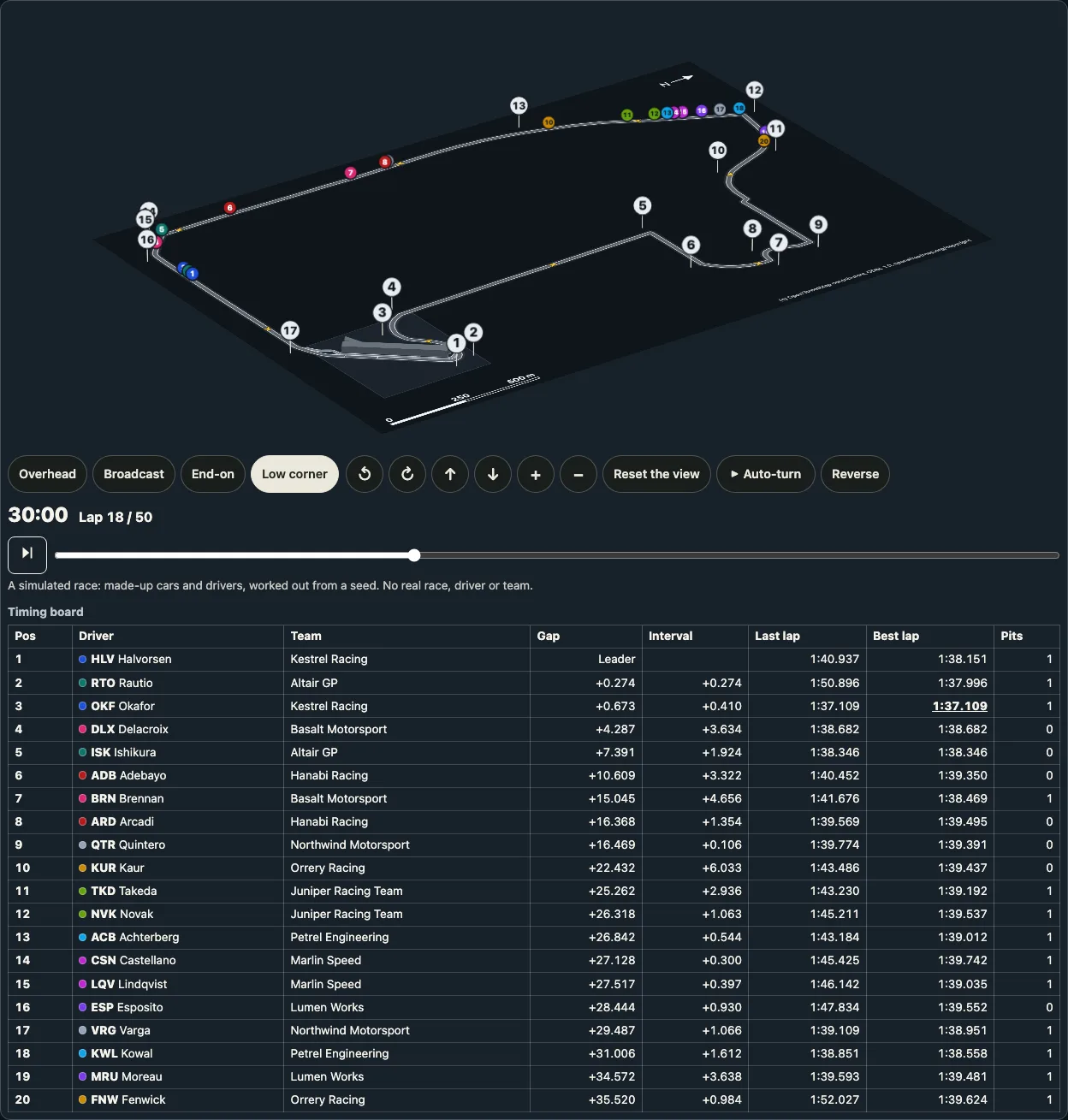
The scoreboard and the podium. A race has a scoreboard the way an arena does. A timing tower stands beside the start and finish straight, on the side with room for it and clear of the lap and the pit lane: in the plan view as a panel, in 3D as a screen on a post that turns to face the eye. It shows the lap (or the grid, or the flag), the first ten cars with their place, team colour, code and gap, the others as a ticker, and the fastest lap. It says what the timing board says (a test compares them at moments all through a race), changes only when a word changes (written with the board, at most four times a second, never while the race is paused), and tower: false (setTower) leaves it out. A broadcast-style overlay of the same tower floats over the left of the view: off by default, overlay: true (setOverlay; the demo's Tower button, overlay=1 in its address). At the chequered flag the leader's P1 tag turns into the flag, the tower shows the flag and the winner's race time, and a podium card comes over the view with the first three (names, teams, the winner's time and the others' gaps, still racing until a car has taken the flag) and the fastest lap. It has a close button, and a Podium button in the bar (the extra slot) brings it back; taken back before the flag the race hides both, and at the end the card is exactly the finishing order (podiumData). On a phone the card sits under the view instead of over it. It works for the simulated race and for a race from a feed. In the simulated race everything on the card and the tower is made up; in a race from a feed the names and times are the feed's.

The camera follows the leader. A race on a circuit can be watched with a camera that zooms slowly into the leader, moves with them, pans out, and always keeps the leader in view. It is off until the reader asks for it (follow: "leader" or "pack", setFollow; the demo keeps it in the address as follow=leader or follow=pack). The race bar's follow slot has Leader (the leader alone, up to four times closer than the whole circuit, centred on them) and Pack (the leader and the cars just behind, with room round them: it closes in while they bunch and pulls back as they spread, up to six times), and Resume. Pressing the one that is in lets the camera go, and it eases back out to the whole circuit. It is the game camera of following the play with the leader as the puck: the same critically damped spring (slow eased moves, no jump between two frames), a dead zone, and a leash that carries the frame with the leader when the race runs ahead of the easing, so the leader never leaves it, in either mode, at 1, 60 or 600 times speed (a test plays whole races to hold that). After a pass it goes to the new leader without a jump. Flat, it shows part of the drawing by its viewBox; in 3D it is a point of the floor to look at and a zoom on top of the view's own, so every viewpoint keeps its angle. The reader's own turn, tip or zoom of the 3D view holds the camera until Resume, and a viewpoint or Reset takes it back to the whole circuit. With reduced motion each step puts the camera where it should be at once. While the camera is close in, the drawing's own map credit is out of frame, so the credit stays on the view as text (ODbL requires it).
Auto-follow, beside Auto-turn. In 3D the view's buttons have an Auto-follow toggle right after Auto-turn, made like it, in a race and on a game's replay alike. Both can be on at once: the view turns slowly while the camera follows the leader, and that is the picture of this page.

It costs nothing of its own: the camera moves inside the race's own animation frame (in 3D, the one frame the view and the race share), nothing runs while the race is paused, the page is hidden or the view is out of sight, and off and at rest it does nothing at all. e2e/race.demo.mjs holds the freeze and leak budgets with it on (flat and in 3D, the leader and the pack) and that it shows the leader at every sample.
It runs on any circuit. Nothing of the race is Las Vegas's own: the speeds come from the line, the pit lane from the circuit's own, the grid from its start line and the laps from its length, and a test runs a race on every circuit the package draws and holds every dot on the road or in the pit lane.
On a district's ground too. The same race runs among the venues and the city round its circuit: the Las Vegas district puts the dots on the Strip Circuit, laid on one plan with T-Mobile Arena, the Sphere and the hotels along the Strip, flat or in 3D (drawDistrictRace, mountDistrictRace), and the link from the demo's circuits page to its district page takes the race along.
Adding the next circuit#
A circuit is mostly data: an entry in scripts/circuits.data.json, a fetch and a build. For Monaco, Spa-Francorchamps or Indianapolis:
- Find the relation. Look in OpenStreetMap for the circuit's relation (
type=circuitorroute=circuit, tagged with the circuit's Wikidata item), its member ways withforwardorbackward, itspit_lane, and itsstartandfinishnodes; and the area of the circuit (aleisure=sports_centreor alanduse=way named for it) and the pit building inside it. Monaco's lap is the streets of the principality, so like Las Vegas it is likely to be a relation over ordinary roads; Spa's and Indianapolis's are likely to behighway=racewayways of their own. Look before you write the record: none of the three has been read yet. If the relation has no turn nodes (junction=yeswith aref), the turns' numbers are left off and the docs say so; they are never placed by guessing. - Write its record.
id,wikidata,osm(relation,area,pitBuilding), theenandjaarticles, and the facts:names(Wikidata's labels),country,opened,lengthandcorners(with the infobox line they were read from),direction(with the sentence that says it), andwidthandpitLaneWidth, eachdocumentedwith its source orplausibleand ours. A circuit with several layouts (Indianapolis's road course and its oval) is a record per layout, each its own relation. - Fetch it once.
pnpm circuits:fetch <date> <id>asks Wikidata, both Wikipedias and Overpass, one request at a time with a pause, and keeps the answers indata-sources/circuits/<date>/. - Build it.
pnpm circuitschecks every documented fact against the raw answers and the lap against the published length (3 percent), and writessrc/circuits.data.tsandsrc/circuits.osm.data.ts. A circuit whose lap crosses itself (Suzuka's figure of eight) needs one thing more: the crossing as data (which part passes over, from the relation'sbridgeorlayertags on its ways), drawn as a gap in the lower ribbon in 2D and a bridge standing over it in 3D. - Credit it. A row in
NOTICE.md(andNOTICE.ja.mdfor the Japanese article), and this page's table. The demo's page and the tests take every circuit ofCIRCUITSby themselves.
Sources and licences#
- OpenStreetMap, ODbL 1.0, (c) OpenStreetMap contributors. The lap, the pit lane, the ground, the pit building, the turns' numbers, the start and the finish, read with the Overpass API on 2026-11-03 (relation/16696508, the area way/233786564, the building way/1198427833). They live only in
src/circuits.osm.data.tsand indata-sources/circuits/, are never copied into a CC0 or CC BY-SA file of the package and no such file is copied into them, and are offered under the ODbL with the creditCIRCUIT_ATTRIBUTION(the venues' own words:(c) OpenStreetMap contributors, ODbL 1.0, openstreetmap.org/copyright). A drawing made from them is a produced work: it carries the credit, in its corner and in its description. - Wikidata, CC0. The labels in English and Japanese, the country (P17) and the day it opened (P1619) of Q113112116.
- English and Japanese Wikipedia, CC BY-SA 4.0. The length, the number of turns and the direction, each with the article and the revision (
Las Vegas Strip Circuit, 1376988769;ラスベガス・ストリップ・サーキット, 108197128); the facts are numbers and words of ours, not the text. The articles are credited in NOTICE.md. - Raw answers are kept as they were returned in
data-sources/circuits/2026-11-03/(osm-las-vegas.jsonwith its query and the time of OpenStreetMap's data,wikidata.json,wikipedia.jsonwith the infobox lines and the sentences read, as evidence).
Limits#
- The lap is the middle of the carriageway OpenStreetMap maps, not a racing line; the track's width is one plausible figure along the whole lap, so where the real track is wider or narrower the ribbon is not.
- The barriers, the grandstands and the bridges for pedestrians over the Strip are not drawn: only what the circuit's relation and its area map. The hotels and the Sphere beside the lap are the district's, with
circuitand its surroundings. - The race is a model: the dots run on the middle of the carriageway, not a racing line, so two cars side by side are one dot over another; there is no safety car, weather or named tyre, and nothing of a real race.
- One circuit so far. Suzuka, with its crossing, is the next in mind, and the steps above say what it needs.