The pages are in English; this contents, the search and the buttons are in Japanese.
Documentation
Kyogijo Stadiums draws sports surfaces as SVG, to scale, with the score on them. The README is the pitch and the first minute; these pages are everything else. The same pages are on the docs site, with a search over their titles and headings and a gallery that draws every picture from the code beside it.
Browse by sport
Each sport with a picture drawn from its code, its guide and its pictures.
-

Hockey
The NHL rink and every league's rinks, the situation of a game, the thirty-two real arenas.
-

Basketball
The NBA, FIBA and college courts, a maple floor with grain, the arenas.
-

Baseball
Ninety-four ballparks with their fences as published, past parks in their seasons, walls and quirks.
-

Football
NFL, CFL and IFAF fields, high school sizes, the down and distance, the stadiums.
-

Soccer
A pitch to the Laws of the Game at any size, mowing patterns, goal styles, sixty-four grounds.
-

Curling
A sheet from the rulebooks, the house, the stones of an end, a folded view of both houses.
-

Net and racket
Tennis, volleyball, badminton, pickleball, table tennis, padel, squash and more, each in its looks.
-

Field sports
Lacrosse, rugby, Australian football, Gaelic games, cricket, field hockey and handball.
-

Water
The 50 m and 25 m pools, water polo, the diving well, artistic swimming, race replays.
-

Athletics
The 400 m track with every start worked out, hurdles, the steeplechase, the field events.
-

Skating
Long track, short track and figure skating, each race's lines lane by lane.
-

Budō
Judo, karate, kendo, sumo, kyūdō and a dojo of tatami laid as real units, the Kodokan.
-

Combat sports
The MMA cage, boxing rings, wrestling mats and a professional wrestling ring.
Venues and districts
Real buildings as OpenStreetMap maps them, in 3D, each with the page of the demo that shows it live.
-
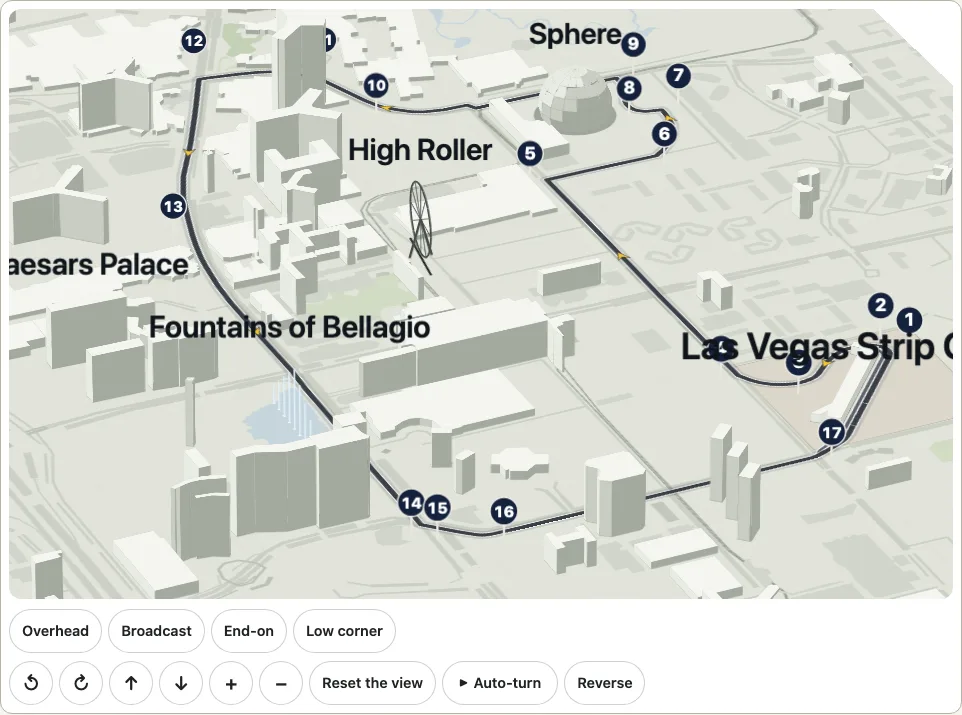
Las Vegas
The Strip Circuit and T-Mobile Arena on one ground among the Strip, with the Sphere, the High Roller and the Fountains of Bellagio.
-
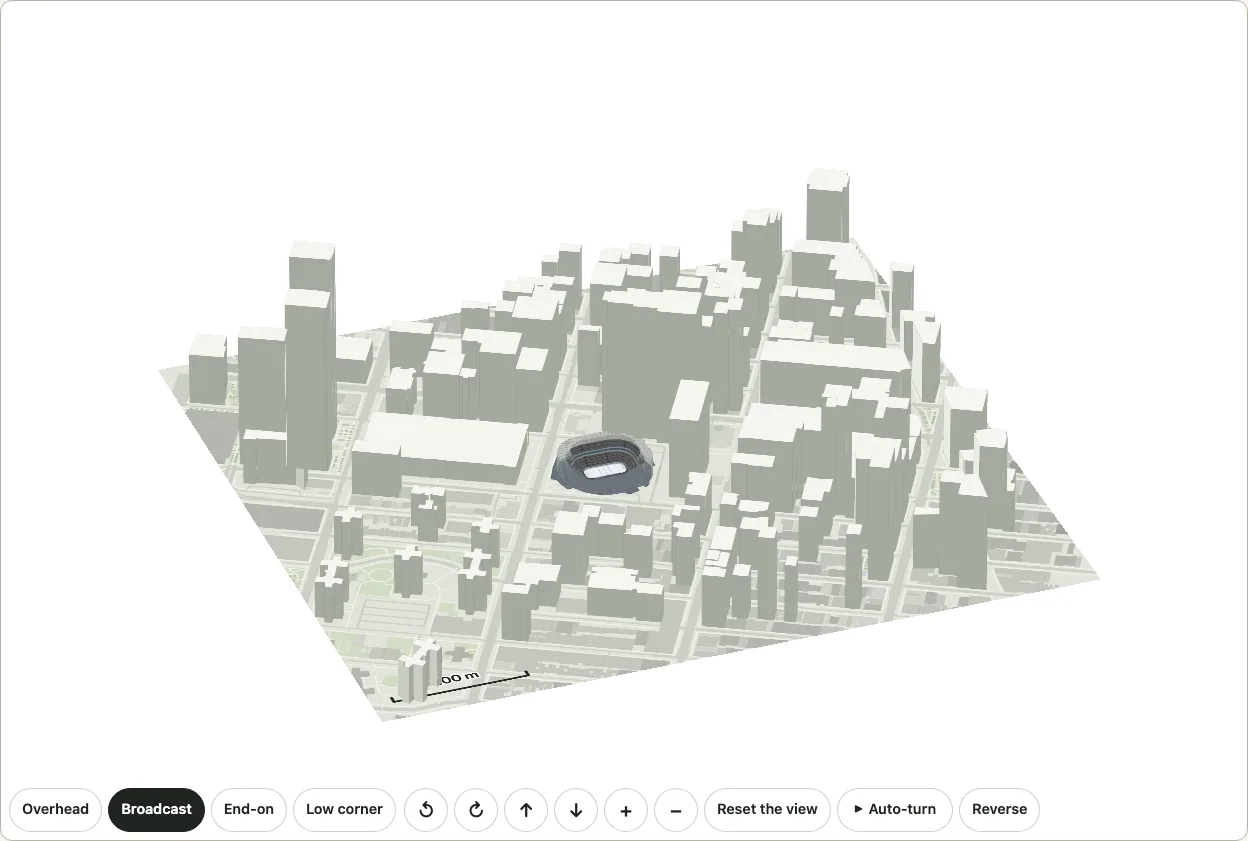
New York
Madison Square Garden among the blocks of Midtown, Yankee Stadium, Citi Field, MetLife Stadium and Barclays Center, six venues on one plan.
-
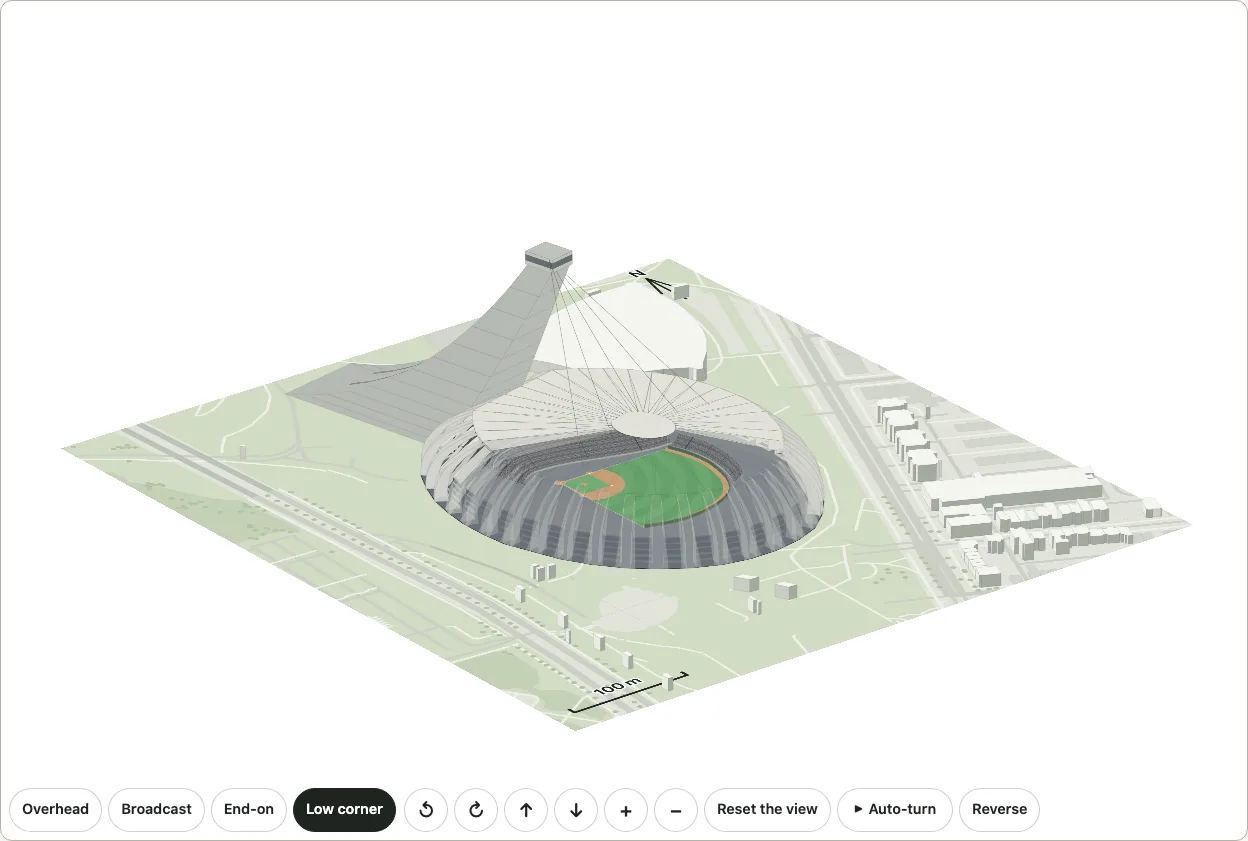
Montreal
The Olympic Stadium with its 38 ribs and its leaning tower, and the Bell Centre, six kilometres away.
-
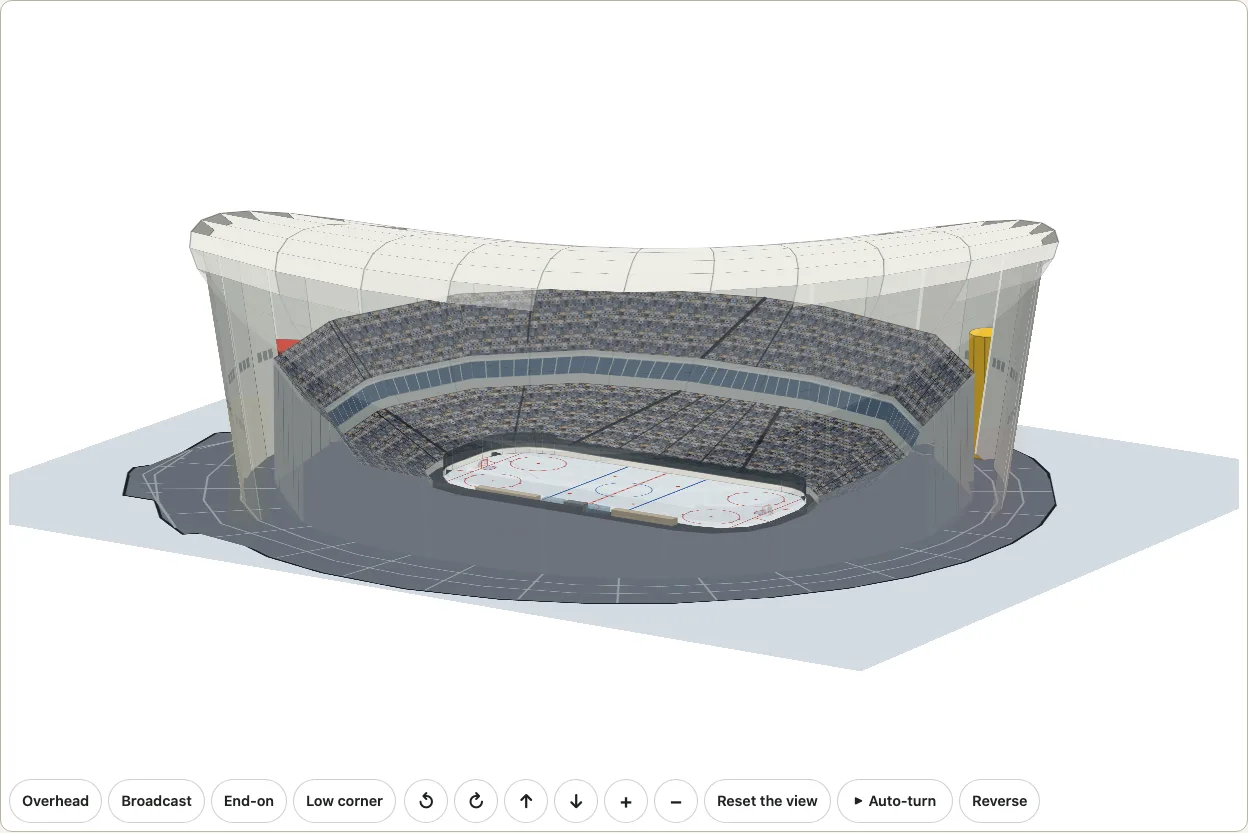
The Saddledome
A round building under one saddle-shaped roof: a net of quads on a reverse hyperbolic paraboloid.
-
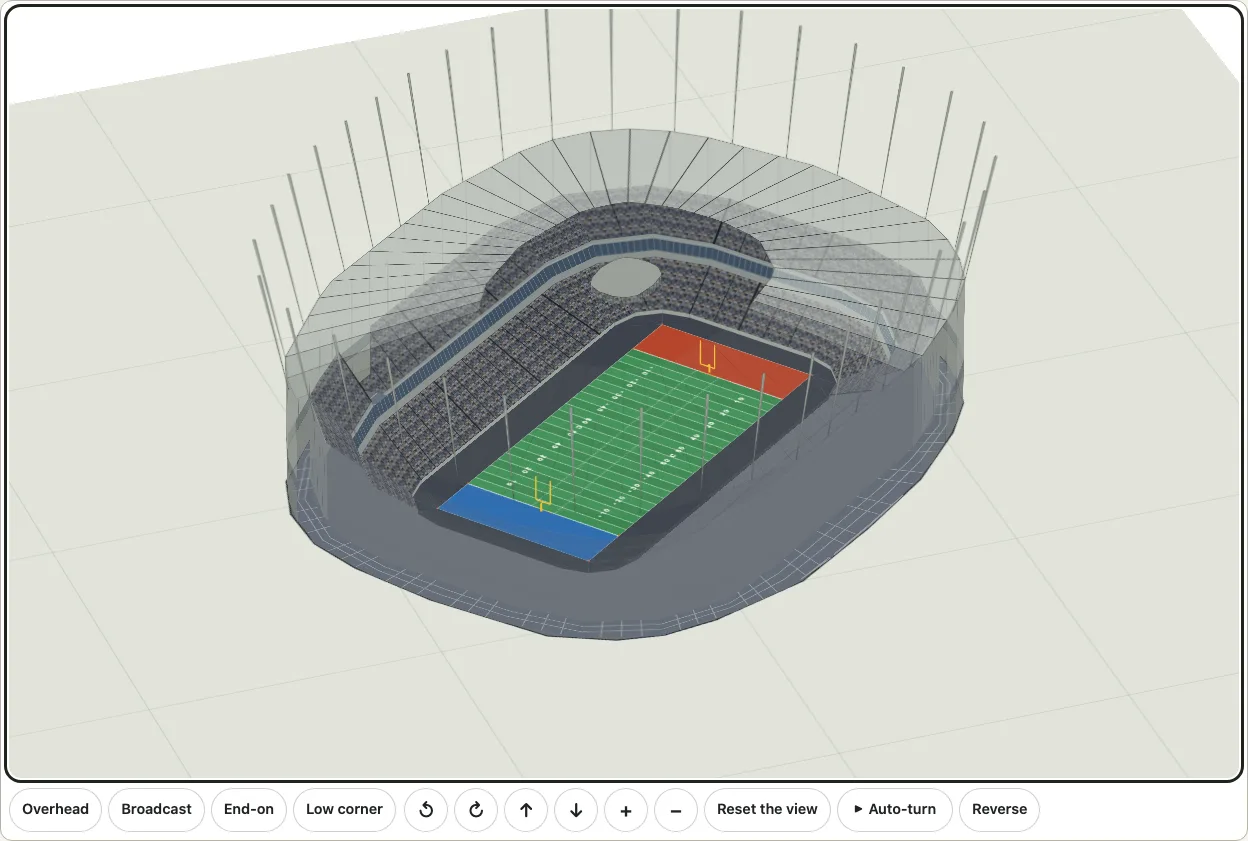
The roof switch
A Roof pill on every page with a 3D view of a venue: on or off, and open where the roof retracts, kept in the address.
-
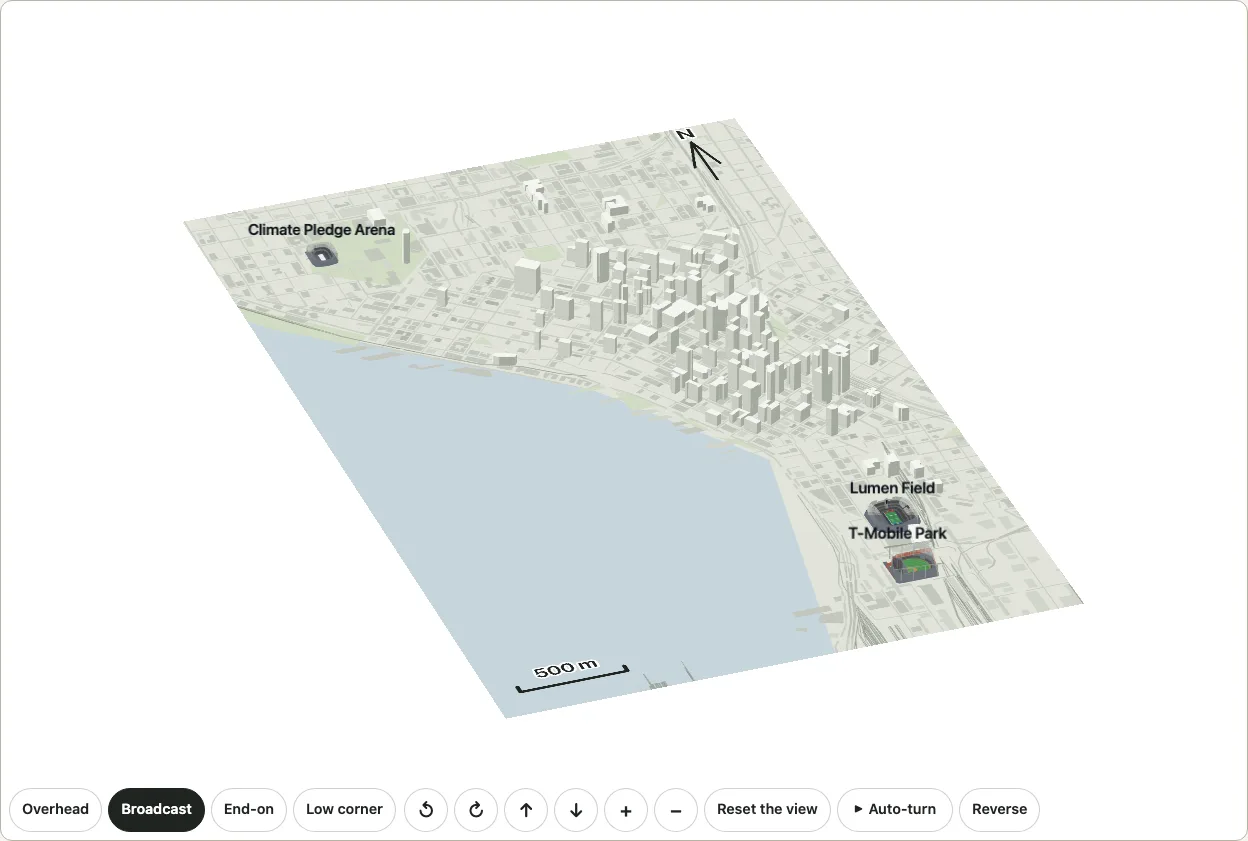
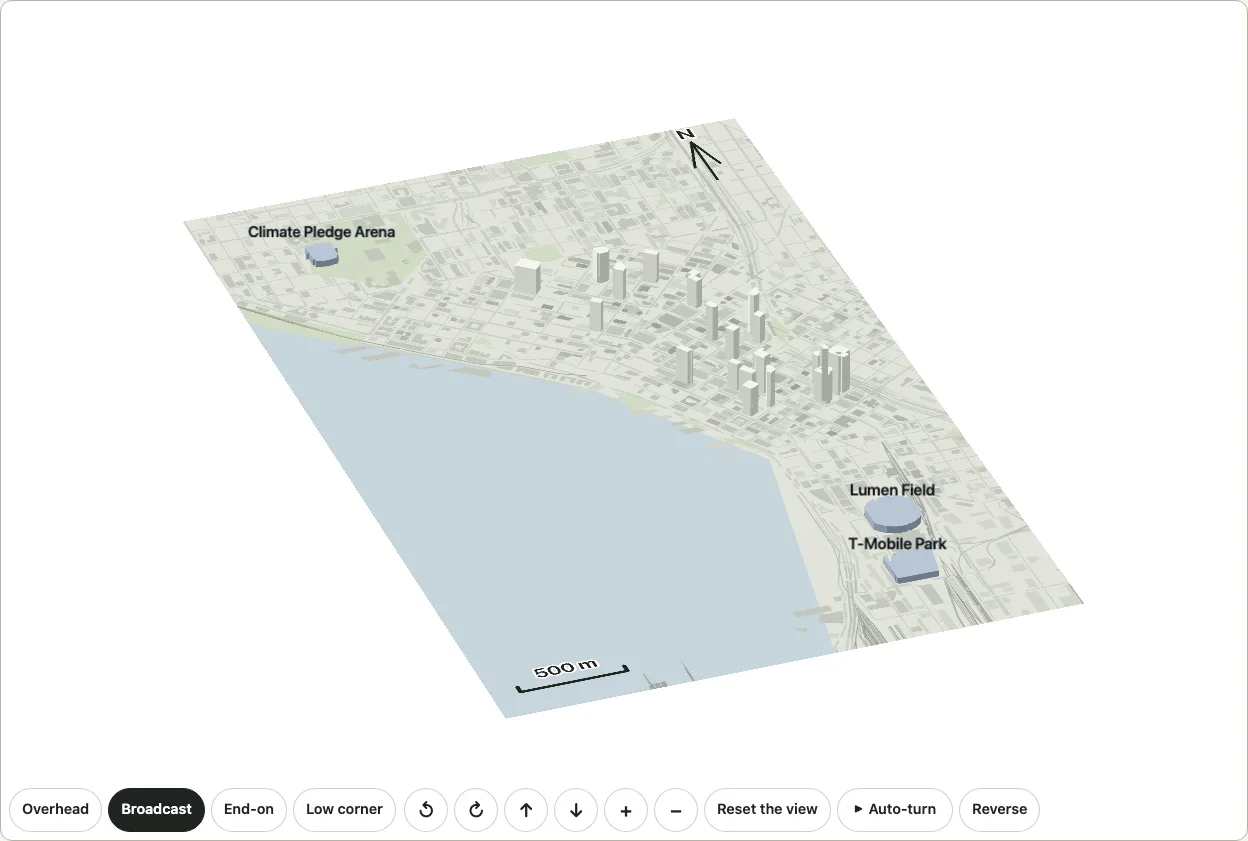
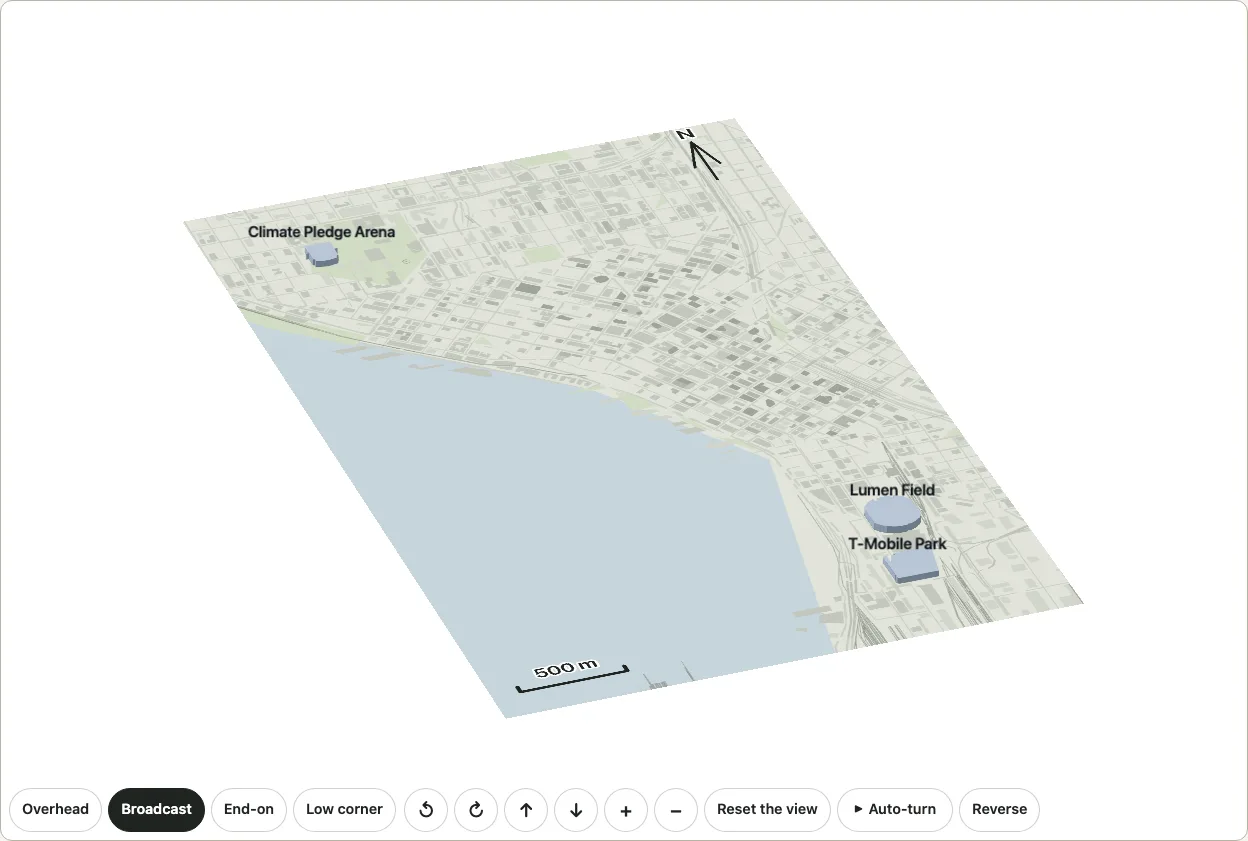
Quality levels
High, medium and low: how much a district draws, chosen by the frames the view really makes.
-
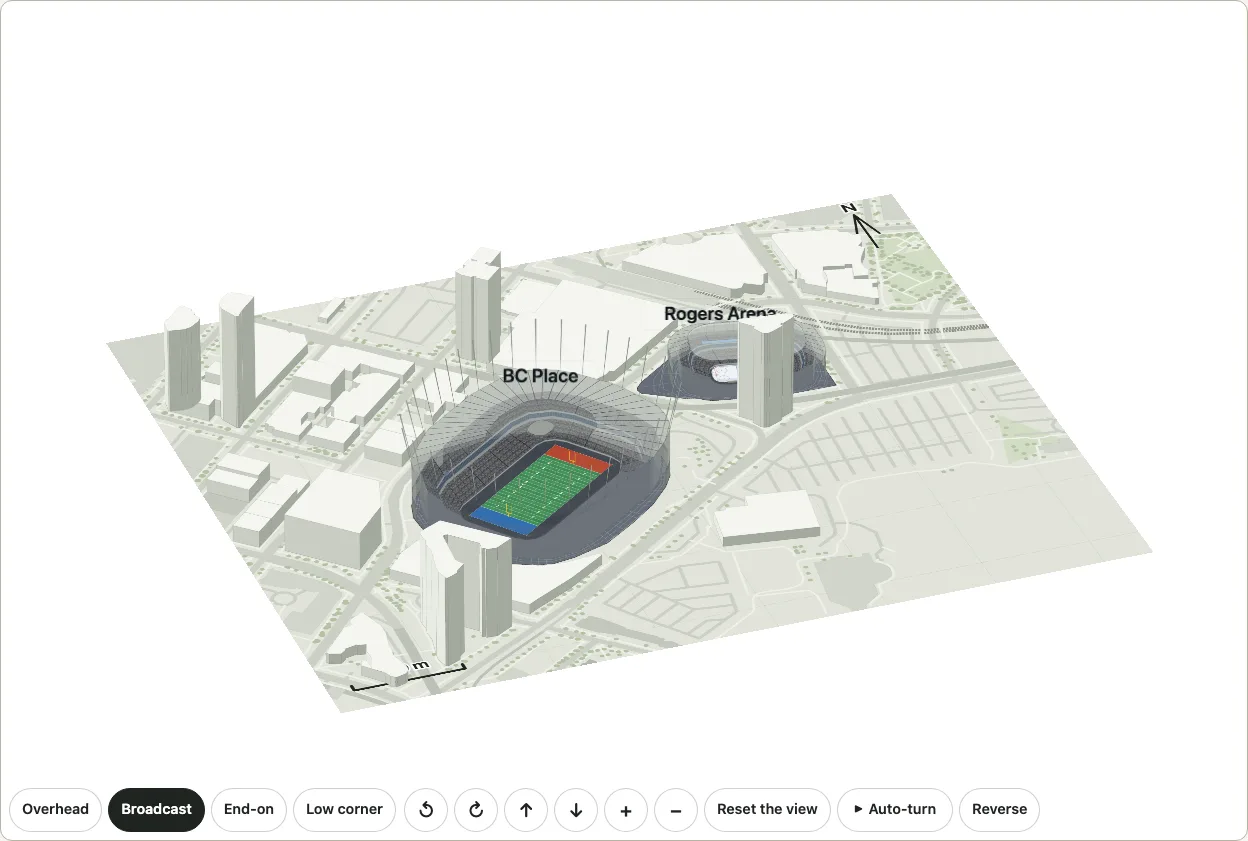
Vancouver
BC Place and Rogers Arena on one plan, with the streets between them, every gate, and a crowd outside on the sidewalks.
-
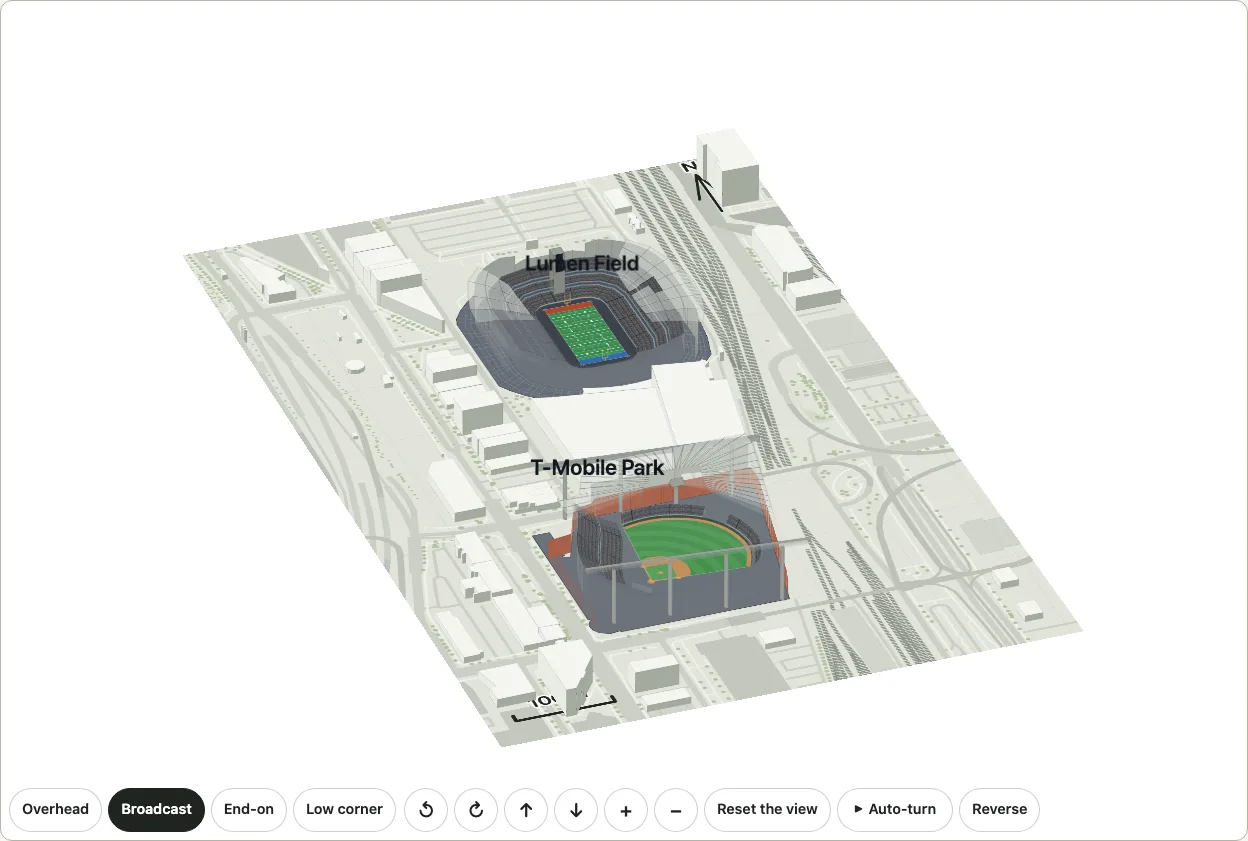
Seattle
Lumen Field, T-Mobile Park and Climate Pledge Arena, the city between them, Elliott Bay to the west.
-
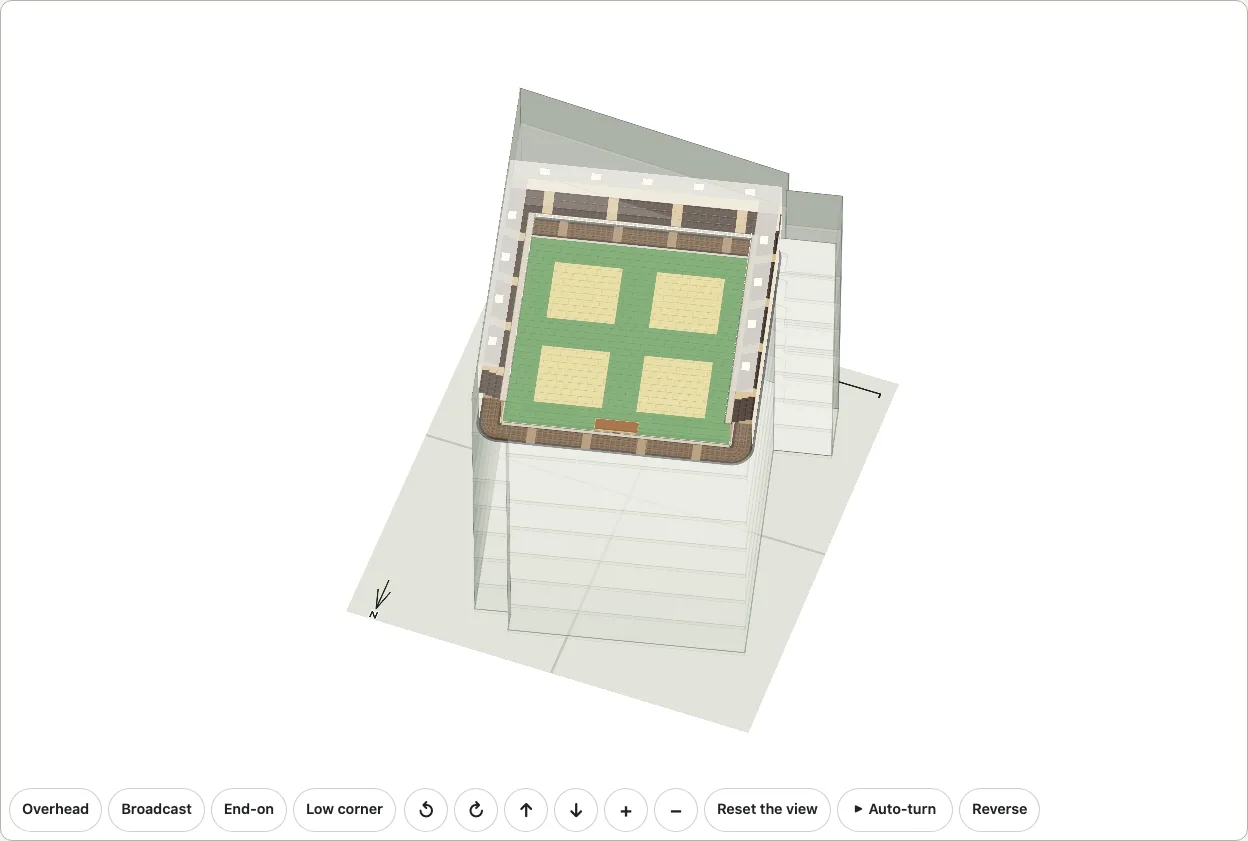
Tokyo and the Kodokan
Tokyo Dome, Korakuen Hall and the Kodokan's great dojo in the air on its real floor, among PLATEAU's buildings.
-
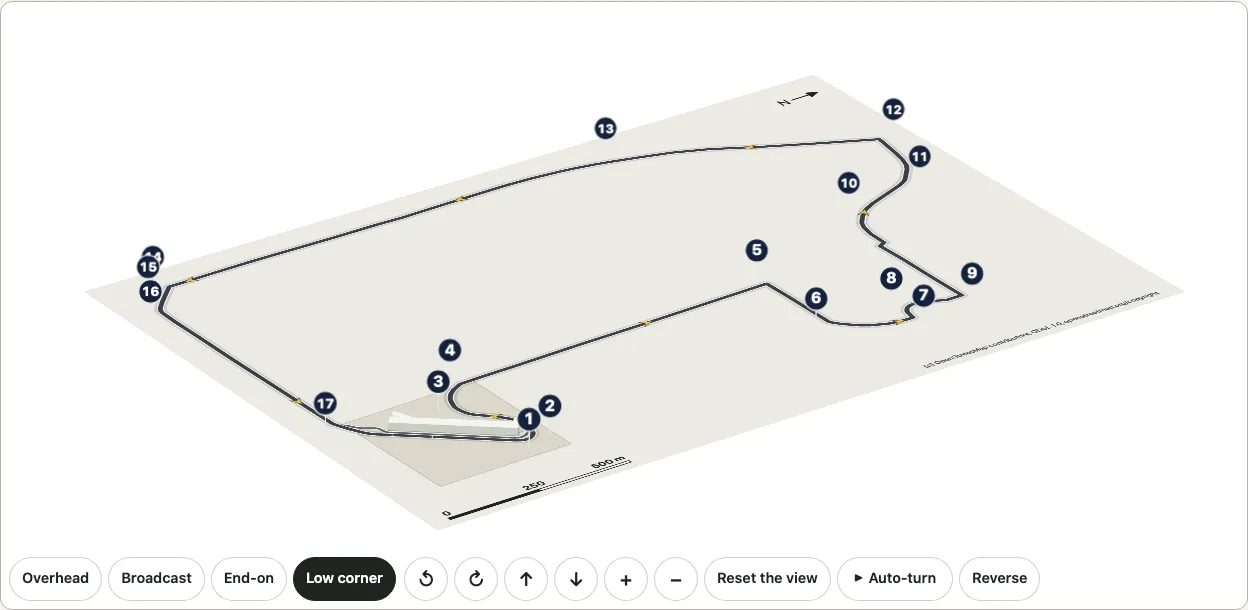
The Las Vegas Strip Circuit
A race track as OpenStreetMap maps it: the lap at the track's width, the pit lane and the pit building, the start and the finish, the 17 turns numbered, in 2D and 3D.
-
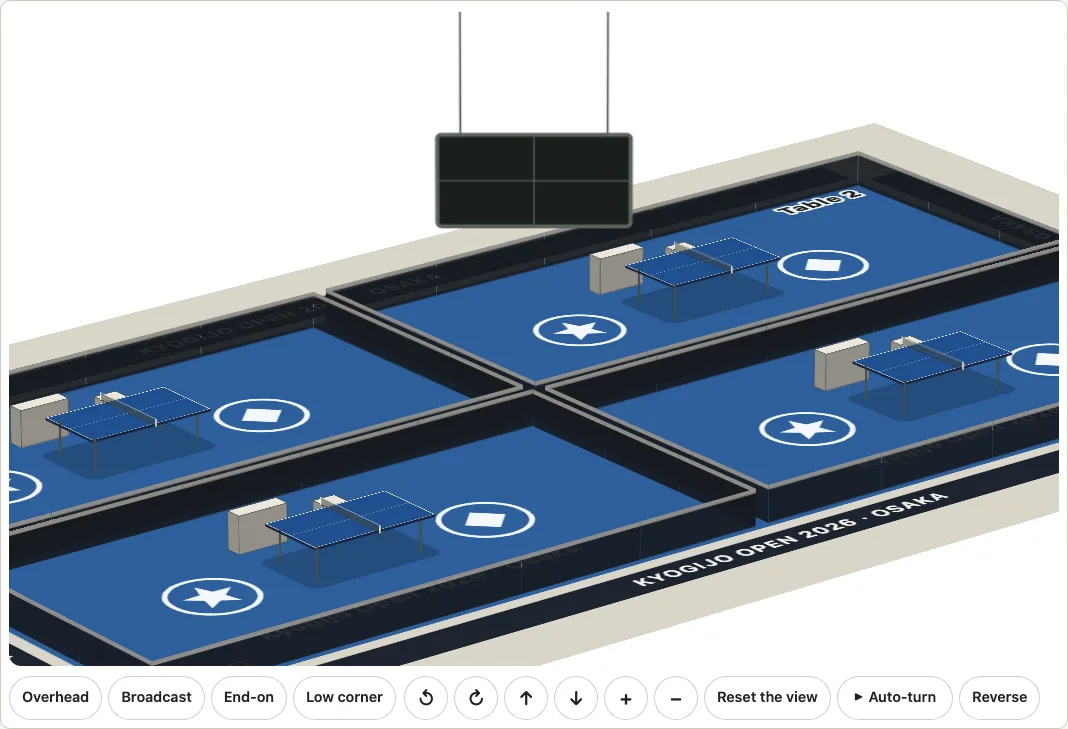
Tournament halls
Judo, table tennis and other areas on one floor, to scale, in a hall or a stadium, flat or in 3D.
-
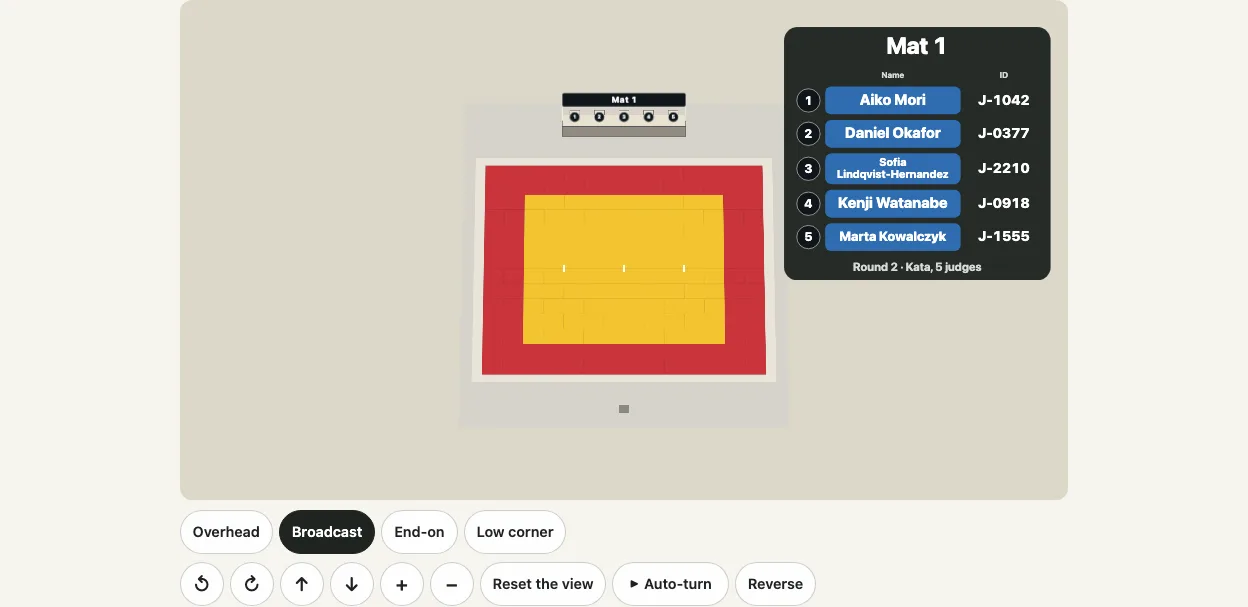
Who judges where
Each mat's officials by seat, a broadcast view with the officials on a board, and a page to print.




Browse by task
Draw a game
A surface with the teams and the score, in your colours.
Show a real venue
Arenas and stadiums in the outline of their buildings.
Turn it in 3D
A floor that turns, the stands, the roof, the night.
Put data on a surface
Shots, heat maps, passes, a replay, in any provider's numbers.
Lay out an event
Several mats or tables on one floor, the judges, the boards.
Look something up
Every entry, limit, source and the other packages.
All the pages#
The contents of the site, by task. On the site the same pages are also listed by sport.
Start here#
- Getting started: install, the four ways in, the element and the frame.
- Recipes: short examples to copy, one for each thing the package does.
- The surfaces: the forty-three surfaces and how a league's rules change one.
- Score and layout: the teams, the score, the strip for a list, wide and tall.
- Theming: every colour, light and dark, the eight named looks, colours by feature, line widths and dashes, goal styles and mowing patterns.
- Annotations: the direction each team attacks, axes in any frame, and the names of a surface's parts.
- Display ranges and zoom: a drawing cropped to a zone, a half, the red zone, the penalty area, the infield, a curling house or a box of your own.
- The situation of a game: hockey's strength, empty net and shootout, baseball's bases, outs and count, football's down, distance and drives, on the surface, in the badge and in the description.
- The pageant: each team's flag or crest laid large over its half, as a carpet or on a round stage, with an emblem in the centre, and the score kept readable.
- Emblems: trophies, medals, balls and crests from the sister package Dougu Sports, plugged in with one line (
useEmblems(renderEmblem)) so that an id goes wherever a logo does. - Flags: a team's country code drawn by Hata, plugged in with one line (
useFlags(render)), in round marks, banners, badges, the pageant, swimmers' and players' badges and charts, with no dependency added. - Layouts and backgrounds: small multiples with a title, a key and a credit line, in a size for a card or a phone, and patterns or a photograph behind a drawing or a grid.
- Accessibility: what each drawing says to a screen reader.
Sports and places#
- Soccer: sizes, mowing patterns, goals, shoot-outs and the providers' coordinates.
- Curling: the sheet from World Curling's and Curling Canada's rules, the board with the hammer, and the stones of an end scored by the rules.
- Net, racket and court sports: the courts of tennis, volleyball (beach and sitting), badminton, pickleball, table tennis, padel, squash, racquetball, sepak takraw, teqball, roundnet and netball from their rulebooks, their looks, the board of sets and games with the server's ball.
- A realistic basketball floor: maple boards with staggered ends, grain and tone, stained paint, the baskets and their shadows from above, and a satin sheen, in every league, with the detail dropping at small sizes.
- Lacrosse, rugby, Australian football and the other field sports: lacrosse (the field and the box), rugby union and league, Australian football, Gaelic football and hurling, cricket, field hockey and handball from their rulebooks, with goals and behinds, goals and points, and a board of runs and wickets.
- The stands and the crowd: the seating bowls, sides, horseshoes and ballpark grandstands round a surface, the seeded crowd in the home and visitors' colours with the empty seats showing, a soccer pitch inside a gridiron stadium, and the stands as data.
- Swimming, water polo, diving and artistic swimming: the four pools from World Aquatics' Competition Regulations: the swimming pool in lanes (50 and 25 m, ropes, floor markings, blocks, panels, flags, a side section), the water polo field, the diving well and the artistic swimming area, the look of the water and the deck, the lanes of a race with flags, places, times, reaction times, splits and pace, a race replay and a natatorium of several pools.
- The athletics stadium: the 400 m track of World Athletics with its staggers, curved starts, relay zones, hurdles and steeplechase, every field event, a close-up of each start and the finish, the covered track, and lane draws, results, a race replay and the marks of throws and jumps.
- The skating rinks: the ISU's 400 m speed skating track with the lines of every race, the short track oval and the figure skating rink, with pairs, starting positions, results, a race replay and the elements of a programme.
- The budō: judo and karate competition areas, the kendo shiai-jo, the sumo dohyō, the kyūdōjō and a dojo builder that lays tatami as real units, with five famous halls, the scores and the sources.
- The combat sports: the MMA cage, the boxing ring, the wrestling mats and the professional wrestling ring, in 2D and 3D.
- Tournament layouts (demo): several surfaces laid out together for one event, to scale (four table tennis areas under one scoreboard, three judo areas on one floor of mats, four curling sheets, a block of pickleball courts), the floor each preset needs, the halls whose floors are published and whether a layout fits one, empty places for the event's own branding, and a real stadium round the floor.
- Boards over a surface (demo): a results board, a bout presentation or a medal table laid over a pool, a mat or an oval, in 2D and in 3D: placed at the top, a side or a corner, kept off the middle of the surface, never stretched.
- Judging assignments (demo): who judges where at a judo tournament: each mat's judges by seat with a name and an ID, in the seat where they fit and in a chart that never cuts a name, in 2D and 3D, for a tablet.
- Circuits (demo): a famous race track as OpenStreetMap maps it, the Las Vegas Strip Circuit first: the lap at the track's width, the pit lane and the pit building, the start and the finish, each turn's number, in 2D and 3D, and a simulated race on it with a race clock and timing board.
- The race feed: kyogijo's open race timeline, the OpenF1-style adapter, and a race from an address, pasted or from a file, followed while it is live.
- Where to find a feed: the known public feeds for each sport, what each gives, a sample address, how to find an id, and each source's docs and terms.
- Special games: a rink in a ballpark, a court on a carrier's deck, baseball over a stadium's pitch: 18 games to scale, each with its sources.
- Ballparks: 94 parks, each with its own fence, and the past ones by season.
- The grounds: 64 soccer grounds, each pitch at its published size.
- The arenas: 167 arenas of the NHL, the NBA, the WNBA and the PWHL, with the size of a rink where an article gives one.
- The real venues: all thirty-two arenas of the NHL (the Pacific, Central, Atlantic and Metropolitan Divisions) drawn in the outline of their buildings (OpenStreetMap) with a plausible bowl of the seats, tiers and roof the sources give, in 2D and 3D.
- Roofs we still need photos for: the thirty-two NHL arenas, the roof each draws today, what open sources say of its shape and the one photo each still needs.
- The fly-through (demo): one smooth camera from a chizu map down to the city and the building of a real arena, which rises into the 3D arena and turns; reduced motion shows each stage as a still.
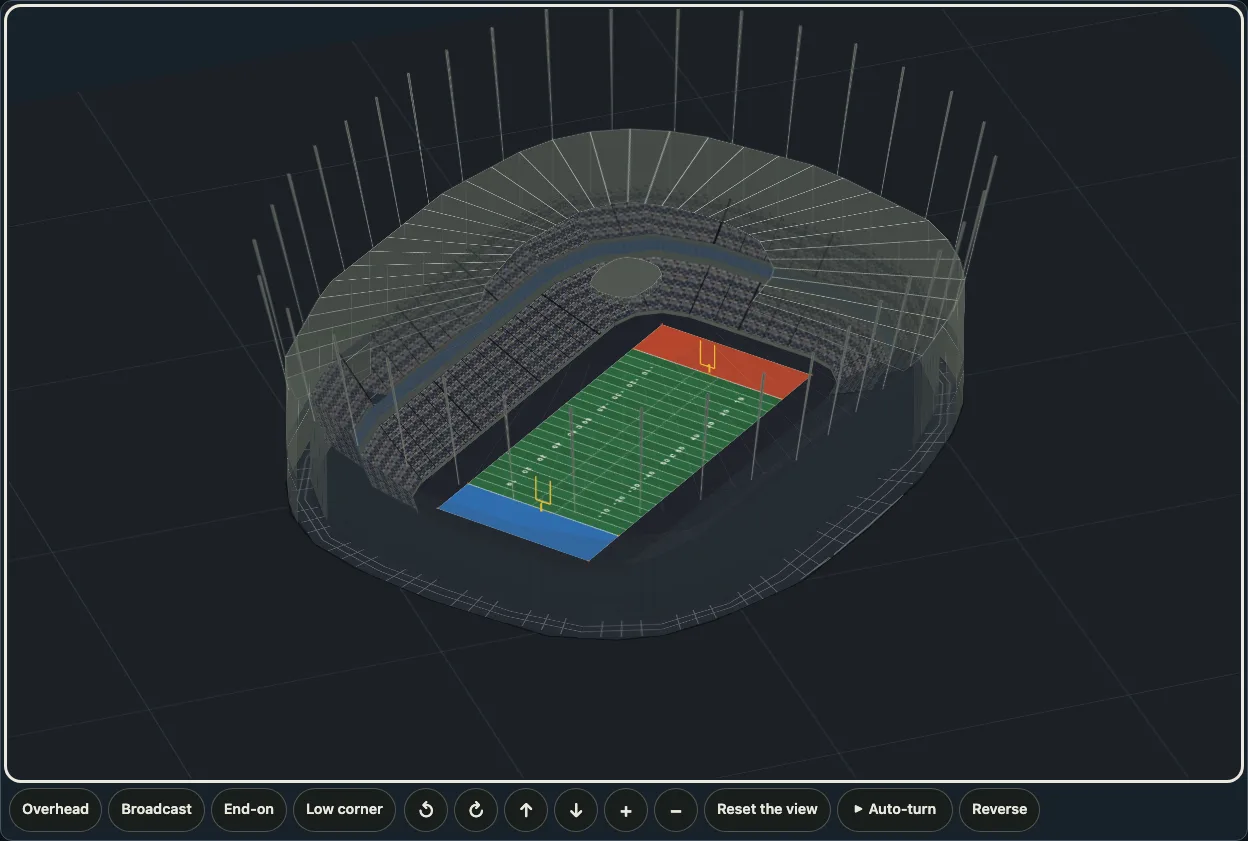
- The real stadiums: BC Place for football and soccer, drawn in the outline of its building (OpenStreetMap) with its retractable, cable-supported roof and a plausible bowl of the seats the sources give.
- The gates of a venue: where the crowd goes in: points on a building's outline with the way each faces and how each is known, marked on a district's plan, for the queues of the crowd's walk in and out.
- The crowd outside the venue: people on the sidewalks, plazas and grounds round a district's venues, at 0, 25, 50, 75 or 100 percent of the seats, drawn as one canvas, on ground OpenStreetMap maps (Vancouver first).
- A district of venues: several real venues of one city on one plan at their real positions and orientations, in 2D and in 3D, tight round neighbours or at the real distances of a city.
- Quality: how much the 3D view draws, so that it turns well on every device: three tiers,
autoby the frames the view makes, and the pixel ratio of the layers. - League variants: the WNBA, FIBA, the NCAA, the IIHF, Little League and more, each from its rulebook.
- Surfaces through the years: the markings of a season, each change cited.
- The atlas: every park, ground and arena on a map.
- The catalogue: every venue drawn today, being built or wanted, with every venue of five leagues' seasons, as a JSON file and a typed entry.
Data on a surface#
- Units: each surface in its rulebook's unit, and the conversions.
- Coordinate frames: where each data provider puts a point, and how to move it onto a surface.
- Zones and the rules: where a point lies by a sport's own rules (the zone, the crease, the paint, the six-yard box, the warning track, the red zone), the yes-or-no questions, and home runs from a park's own fence and wall.
- Pointing at a drawing: a click as a place on the field in any provider's numbers, with its zone, and the way back for a marker.
- Data layers: points, lines, arrows, text and the heat layers, every mark carrying its id, its index and its zone.
- Ready-made charts: a shot chart, a shot map, a spray chart, a pass chart, a soccer shot map, the stones of a curling end, the splits of a swimming race, and a pass network (the road to a tournament's final is in
@johnmorrisdotca/taisen-brackets, its/roadentry). - Goal mouths, the strike zone and the stumps: a goal seen from the shooter's side in six sports, the catcher's view of the plate with its nine and thirteen zones, and the wicket from the bowler's end, with the shots, pitches and deliveries on them.
- Team shape: pass networks, formations, lineups, Voronoi cells, triangulations, hulls, flow fields and sonars.
- Replay: tracking data played on a surface, with controls, a keyboard, a live region and steps for reduced motion.
- Renderers: the drawing as plain data, on a canvas, in a d3 selection, in an Observable Plot, as GeoJSON and as a PNG.
Gallery and comparison#
- Gallery: every surface, league, season, park, ground, layer, heat map and chart, drawn from the code shown beside it.
- How it compares: a table against the other packages that draw playing surfaces.
Reference#
- Entry points, and the API reference for every export.
- Limits: the numbers a test holds.
- Sources of the dimensions and References: where each figure was read, and what may be used of each reference.
- The keys of the ballparks, and the Japanese of Kyogijo: every word in both languages.
- Terminology: the Japanese words of the rule books that the docs rest on, beside the English.
- Each page is in one language. The pages in Japanese (named
<name>.ja.md) are on GitHub beside their English twins: ballparks, grounds, league variants and the notice of the data's sources. - Architecture: the files and what each is for.